


Next: Hale DMO and its
Up: Amplitude-preserving AMO
Previous: Chaining DMO and inverse
DMO is a method of transformation of finite-offset data
to zero-offset data. Let the normal moveout corrected input data be
denoted  and the zero-offset desired
output denoted
and the zero-offset desired
output denoted  . Assume known relationships between
the coordinates of the general form
. Assume known relationships between
the coordinates of the general form
|  |
(14) |
The DMO operator can be
defined in the zero-offset frequency  and midpoint
wavenumber
and midpoint
wavenumber  as Liner (1988)
| ![\begin{eqnarray}
P_0(\omega_{0},{\bf k}_0;{\bf h}=0)&=&\int d{\bf x}_2 \frac {d{...
...bf x}_2)\right]} P_2(t_2,{\bf x}_2;{\bf h}_2), \
\EQNLABEL{dmo.eq}\end{eqnarray}](img49.gif) |
(15) |
| (16) |
whereas its inverse can be defined as
| ![\begin{displaymath}
P_2(t_2,{\bf x}_2;{\bf h}_2)=\int d{\bf k}_0 \int d\omega_o ...
...t]} P_0(\omega_{0},{\bf k}_0;{\bf h}=0) \\ \EQNLABEL{dmoinv.eq}\end{displaymath}](img50.gif) |
(17) |
where
|  |
(18) |
A detailed derivation of J2 is given by Liner 1988.
The method
is based on a general formalism Beylkin (1985); Cohen and Hagin (1985)
for inverting integral equations
such as dmo.eq.
It involves inserting dmo.eq into dmoinv.eq and expanding
the resulting amplitude and phase as a Taylor series and making a
change of variables according to Beylkin 1985. The solution
provides an asymptotic inverse for dmo.eq, where the weights are given by
| ![\begin{displaymath}
{J_2}=\frac {d\omega} {d\omega_o}\frac{d{\bf k}}{d{\bf k}_0}...
...rac {d{\bf x}_0}{d{\bf x}_2}\right]}^{-1}. \\ \EQNLABEL{jacob2}\end{displaymath}](img52.gif) |
(19) |
In this expression,  is the Jacobian of the change of variables in the forward DMO given by
| ![\begin{displaymath}
{J_1} =\frac {\partial{(t_0,{\bf x}_0)}} {\partial{(t_2,{\bf...
...{dt_2} & \frac {d{\bf x}_0} {d{\bf x}_2}, \end{array} \right]\ \end{displaymath}](img54.gif) |
(20) |
which reduces to  ,
assuming the general coordinate relationships coord.relat where
,
assuming the general coordinate relationships coord.relat where
 is independent of t2, leading to a zero lower left element in
the determinant matrix above.
is independent of t2, leading to a zero lower left element in
the determinant matrix above.
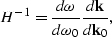
The quantity  is the inverse of the Beylkin determinant, H, and is given by
| ![\begin{displaymath}
H^{-1}=\frac {\partial{(\omega,{\bf k})}} {\partial{(\omega_...
...}} {d{\bf k}_0} \end{array} \right]\; .
\EQNLABEL{Beylkin_inv}\end{displaymath}](img58.gif) |
(21) |
If we recognize that is independent of , then the lower
element of H-1 is zero and Beylkin_inv reduces to
|  |
(22) |
where  and are, respectively,
| ![\begin{displaymath}
\omega=\omega_o \frac {d} {dt_2} \left[ t_0(t_2) \right]
\EQNLABEL{omega}\end{displaymath}](img61.gif) |
(23) |
| ![\begin{displaymath}
{\bf k}={\bf k}_0 \frac {d} {d{\bf x}_2} \left[{\bf x}_0 ({\bf x}_2) \right]\; .
\EQNLABEL{wave.numb}\end{displaymath}](img62.gif) |
(24) |
Notice that and depend on the coordinate
relationships coord.relat. Therefore, the Beylkin determinant, H,
varies according to the DMO operator but is constant
for kinematically equivalent operators.
Next: Hale DMO and its
Up: Amplitude-preserving AMO
Previous: Chaining DMO and inverse
Stanford Exploration Project
1/18/2001