


Imaging is often derived as the adjoint of modeling, where
in the absence of explicit formulation for  we seek an
approximate inverse for
we seek an
approximate inverse for  .
Mathematically, this means that we approximate an inverse
of a matrix of very high order by
the transpose (Hilbert adjoint) of .
Claerbout 1999 points out that unless
has no physical units,
the units of the transpose solution
.
Mathematically, this means that we approximate an inverse
of a matrix of very high order by
the transpose (Hilbert adjoint) of .
Claerbout 1999 points out that unless
has no physical units,
the units of the transpose solution  do not
match those of
do not
match those of  . Given the theoretical (least
squares) solution
. Given the theoretical (least
squares) solution  , Claerbout suggests that the scaling units should be those of
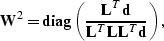
 . He proposes a diagonal weighting function
suggested by Bill Symes (private communication) that makes the image
. He proposes a diagonal weighting function
suggested by Bill Symes (private communication) that makes the image
 , where the weighting function is
 |
(43) |
In contrast to the scaled adjoint, the normalized solution is unitless. It therefore avoids the ambiguity of guessing approximate weights. The model represents a ratio of two images where the reference image is the output of an input vector with all components being equal to one. This is equivalent to a calibration by the response of a flat event. Similar approaches might exist in practice, often derived in heuristic ways, e.g., the DMO fold Slawson et al. (1995).