


In order to compute stable solutions to ill-conditioned systems it is often necessary to apply regularization methods. Claerbout 1997 writes: `` In geophysical fitting we generally have two goals, the first being data ``fitting'' and the second being the ``damping'' or regularization goal''. One way to achieve such objective is to augment the problem with a second regression that adds assumptions about the model (e.g. roughness, smoothness, curvature, energy in one dip, etc...).
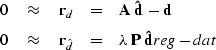
For the data-space inverse, one now solves the problem:
 |
(59) | |
The solution  represents an
equalized data vector that is unevenly sampled. I chose the penalty
operator,
represents an
equalized data vector that is unevenly sampled. I chose the penalty
operator,  , to be the identity matrix.
This is the standard Tikhonov regularization
where the solution
, to be the identity matrix.
This is the standard Tikhonov regularization
where the solution  solves the problem:
 |
(60) |
 is the identity operator
and the damping parameter
is the identity operator
and the damping parameter  is an estimate of the smallest resolved singular value of
  .
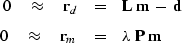
.Similar to the data-space solution, to regularize the model-space inverse one seeks a solution to the system of regressions:
 |
(61) | |
| (62) |
Since the model  is regularly sampled, I chose to be
the Laplacian operator, which represents differentiation in the midpoint-space.
The parameter controls
the smoothness of the solution and is again
an estimate of the smallest resolved singular value of .At the time of writing the dissertation, I didn't investigate a
robust strategy for estimating . However, by processing
a single frequency (e.g the dominant frequency of the survey), I was
able to iteratively guess a good estimate for . Ideally, one
might assume a different value for should be used for
each frequency inversion. Results showed that a single good
estimate of produced
a reasonably smooth solution while still
preserving the high frequency components of the reflectivity function.
is regularly sampled, I chose to be
the Laplacian operator, which represents differentiation in the midpoint-space.
The parameter controls
the smoothness of the solution and is again
an estimate of the smallest resolved singular value of .At the time of writing the dissertation, I didn't investigate a
robust strategy for estimating . However, by processing
a single frequency (e.g the dominant frequency of the survey), I was
able to iteratively guess a good estimate for . Ideally, one
might assume a different value for should be used for
each frequency inversion. Results showed that a single good
estimate of produced
a reasonably smooth solution while still
preserving the high frequency components of the reflectivity function.