


To derive an expression for the amplitudes of the AMO
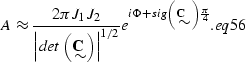
impulse response, we start from the general
expression for the stationary-phase approximation
of the  integral in equation amo_freq.eq as in
Bleistein and Handelsman (1975),
integral in equation amo_freq.eq as in
Bleistein and Handelsman (1975),
 |
(81) |
 , which is defined as
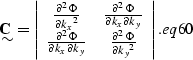 |
(82) |
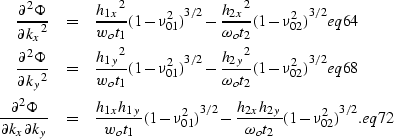
 with respect to kx and
ky and using the definitions of
with respect to kx and
ky and using the definitions of  and
and  yields
the following expressions for
yields
the following expressions for
 ,
,  and
and  :
:
 |
(83) | |
| (84) | ||
| (85) |
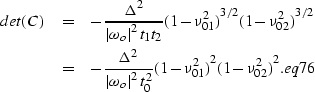
With a little algebra, one may verify that the determinant of the curvature matrix is
 |
||
| (86) |
,which is the product of the two eigenvalues of ,is always negative.
This means the two eigenvalues have opposite signs
and consequently the signature of ,defined as the number of
positive eigenvalues minus the number of negative eigenvalues,
is always null.
Therefore, the second term
of the phase shift in equation eq56 vanishes.
To obtain expressions for the AMO amplitude, we need to substitute equation eq76 in equation eq56, together with the corresponding expressions for J1 and J2. Given a forward DMO with a Jacobian term J1, I showed in Chapter 3 of the main text that an asymptotic inverse provides a better representation for the inverse DMO operator than the approximate adjoint. Also, by restricting the definition of ``true-amplitude'' to preserving the peak amplitude of reflection events, I also showed that an amplitude-preserving function for AMO can be defined by cascading Zhang and Black 1988 DMO with its asymptotic ``true-inverse''; therefore given
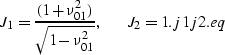 |
(87) |
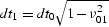 )in the first integral of
equation amo_freq_change.eq,
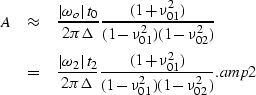
we can write the amplitude term for the AMO integral:
)in the first integral of
equation amo_freq_change.eq,
we can write the amplitude term for the AMO integral:
 |
(88) | |
| (89) |
 ,enables us to apply the differentiation operator
 to the output data;
it is correct because t0 and t2 are linked
by the linear relationship
to the output data;
it is correct because t0 and t2 are linked
by the linear relationship
 .
.
The expression for the amplitudes presented
in equation amo_amp.eq of the main text
follows by simple substitution of
the expressions for  ,
,  ,and
,and  , from equations eq40, eq44 and eq48
into equation amp2.
, from equations eq40, eq44 and eq48
into equation amp2.