


We have already seen that there are several advantages of the differential scheme presented here for purposes of analysis. Another advantage will soon become apparent when we analyze the ratio of the compliance differences
R = 1/G^* - 1/G_dry1/K^* - 1/K_dry.
This ratio is of both theoretical and practical interest. It is of
practical interest because it is often easier to measure
bulk moduli, and it would therefore be possible to estimate the shear
behavior from the bulk behavior if the ratio R were known to be
either a universal constant, or a predictable parameter.
Mavko and Jizba (1991) show that this ratio is given by
 when the differences between the dry and the starred
quantities are due to a small amount
of soft (crack-like) porosity that is liquid filled
for the starred moduli. The derivation of this ratio makes it clear
that the value R = 4/15 is actually an upper bound, i.e.,
a value that cannot be exceeded
for such systems, but also a value
that clearly is not achieved for many systems
lacking such soft porosity. In particular, it was already known
by Mavko and Jizba (1991) that
when the differences between the dry and the starred
quantities are due to a small amount
of soft (crack-like) porosity that is liquid filled
for the starred moduli. The derivation of this ratio makes it clear
that the value R = 4/15 is actually an upper bound, i.e.,
a value that cannot be exceeded
for such systems, but also a value
that clearly is not achieved for many systems
lacking such soft porosity. In particular, it was already known
by Mavko and Jizba (1991) that  when the microgeometry
of all the porosity is
spherical.
The crack-like porosity in Mavko and Jizba's model has finite
compressiblity normal to its plane and is incompressible in the plane
of the crack. Thus, their soft porosity can be thought of as cracks
whose aspect ratios approach zero.
Goertz and Knight (1998) have also done a parameter study
showing that a related ratio (RGm/Km) is generally less than
4/15 for oblate
spheroids and it tends to zero as the oblate spheroids' aspect ratios
approach unity. It would be helpful to see this behavior directly in
the equations, and it is the purpose of this section to show this
behavior analytically.
when the microgeometry
of all the porosity is
spherical.
The crack-like porosity in Mavko and Jizba's model has finite
compressiblity normal to its plane and is incompressible in the plane
of the crack. Thus, their soft porosity can be thought of as cracks
whose aspect ratios approach zero.
Goertz and Knight (1998) have also done a parameter study
showing that a related ratio (RGm/Km) is generally less than
4/15 for oblate
spheroids and it tends to zero as the oblate spheroids' aspect ratios
approach unity. It would be helpful to see this behavior directly in
the equations, and it is the purpose of this section to show this
behavior analytically.
Each of the four material constants appearing in (R) can be computed/estimated using the DEM. But, R is normally defined only in the limit of very small values of soft porosity, in which case both the numerator and the denominator tend to zero. This type of limit is well-known in elementary calculus, and the result is given by L'Hôpital's rule:
R = d(1/G^* - 1/G_dry)/dyd(1/K^* - 1/K_dry)/dy. From this form of R, it is now quite easy to relate the ratio to the P's and Q's discussed earlier. In particular, we find that
(1-y)ddy(1/G^* - 1/G_dry) = 2K_f5G_m _m- 2G_m/3_m(K_f+_m) and
(1-y)ddy(1/K^* - 1/K_dry) = - K_f_m(K_f+_m) (1 + 3(1-2_m)/4(1-_m^2)), and therefore that
R = 415(1 - 34(1-_m))
(1 + 3(1-2_m)/4(1-_m^2))^-1.
[For sandstones, we could instead evaluate (R3) at  and
and  . It is only the soft, crack-like porosity
that needs to be very small for (R3) to be applicable.]
Equation (R3) is an exact expression for the ratios of
these two slopes when the calculation starts at y=0 and
. It is only the soft, crack-like porosity
that needs to be very small for (R3) to be applicable.]
Equation (R3) is an exact expression for the ratios of
these two slopes when the calculation starts at y=0 and
 . It depends only on the aspect ratio
  and
Poisson's ratio
and
Poisson's ratio  of the mineral. It shows a sublinear decrease of R
with increasing , and the value of R reaches zero when
of the mineral. It shows a sublinear decrease of R
with increasing , and the value of R reaches zero when
 . Because the formulas used for the
penny-shaped crack model are valid only for very low aspect ratios,
this latter behavior should not be taken literally. We do expect R
to decrease as the aspect ratio increases, and the trend should be
to zero, but this zero value should only be achieved at
. Because the formulas used for the
penny-shaped crack model are valid only for very low aspect ratios,
this latter behavior should not be taken literally. We do expect R
to decrease as the aspect ratio increases, and the trend should be
to zero, but this zero value should only be achieved at  .This is the type of behavior observed, for example, by Goertz and
Knight (1998).
We will check the quantitative predictions
by doing a numerical study here for oblate
spheroids as a function of aspect ratio. The results will be
similar to those obtained by Goertz and Knight (1998), but not
identical for several reasons: (1) Goertz and Knight plot
RGm/Km (instead of R) for the Mori-Tanaka method
(Benveniste, 1987), (2) the R values presented here
are for an infinitesimal change in soft porosity, and
(3) the present calculation is (therefore) actually not dependent on
the type of effecive medium approximation used, only on the
Eshelby (1957) and Wu (1966) factors P and Q.
.This is the type of behavior observed, for example, by Goertz and
Knight (1998).
We will check the quantitative predictions
by doing a numerical study here for oblate
spheroids as a function of aspect ratio. The results will be
similar to those obtained by Goertz and Knight (1998), but not
identical for several reasons: (1) Goertz and Knight plot
RGm/Km (instead of R) for the Mori-Tanaka method
(Benveniste, 1987), (2) the R values presented here
are for an infinitesimal change in soft porosity, and
(3) the present calculation is (therefore) actually not dependent on
the type of effecive medium approximation used, only on the
Eshelby (1957) and Wu (1966) factors P and Q.
 |
is R = 4/15 in both cases, in agreeement with
Mavko and Jizba (1991).

The appropriate expressions for P and Q for oblate spheroids can
be found in Berryman (1980b). We repeat the analysis given above
in (R2)-(Kdiff) step
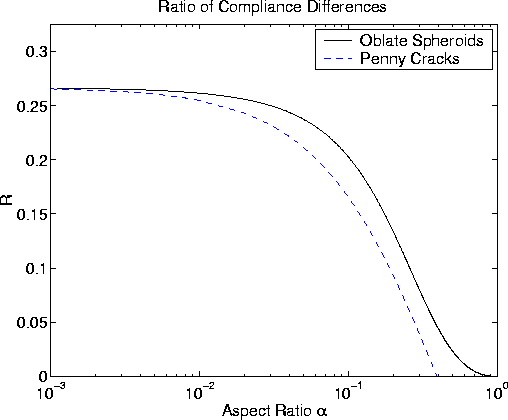
by step for oblate spheroids. The results are shown in Figure 7,
together
with the results obtained using the penny-shaped cracks as presented
already in Equation (R3).
We see that the results agree completely for
's smaller than about 0.001, and are in qualitative
agreement
over most of the rest of the range. As already discussed, the
penny-shaped crack model is a limiting approximation for the
oblate spheroids, and deviations from the curve for oblate spheroids
do not have physical significance; they merely indicate the degree of
error inherent in this choice of approximation scheme.
The results for oblate spheroids should be considered rigorous.