


Next: Source-Receiver Migration
Up: Shan and Zhang: Migration
Previous: Introduction
In shot-profile migration, each shot is treated as an independent physics experiment.
Each shot is migrated separately and
the images of all the shots are then stacked to generate the final image.
The source for shot-profile migration is not necessarily an impulse function. Actually, it is a wavelet
for a point shot in practice. The source can also be a plane wave,
a primary reflection Guitton (2002), or some other configurations.
We assume that the source wavefield is a down-going wavefield and the receiver wavefield is an up-going
wavefield. These two wavefields are downward continued independently. Let  be the receiver wavefield and
  be the source wavefield
at the surface for shot s. The source wavefield at the subsurface
be the source wavefield
at the surface for shot s. The source wavefield at the subsurface  can be obtained by extrapolating
with the up-going wave equation
can be obtained by extrapolating
with the up-going wave equation
|  |
(1) |
and the source wavefield at subsurface  can be obtained by extrapolating
with the down-going wave equation
can be obtained by extrapolating
with the down-going wave equation
|  |
(2) |
where
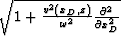 is a pseudo-partial differential
operator Zhang (1993).
The image for shot s is formed by cross-correlating the source wavefield and receiver wavefield along the time axis at all depths and evaluating
this at zero time lag Claerbout (1971).
Stacking the images of all the shots, we can get the image of frequency
is a pseudo-partial differential
operator Zhang (1993).
The image for shot s is formed by cross-correlating the source wavefield and receiver wavefield along the time axis at all depths and evaluating
this at zero time lag Claerbout (1971).
Stacking the images of all the shots, we can get the image of frequency 
|  |
(3) |
and the image of all frequencies
| 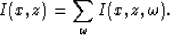 |
(4) |
To perform a velocity analysis, Rickett and Sava (2002) developed the Common Image Gather (CIG) for shot-profile migration,
calculated by
|  |
(5) |
Next: Source-Receiver Migration
Up: Shan and Zhang: Migration
Previous: Introduction
Stanford Exploration Project
7/8/2003