


 are ray coordinates for point sources.
In all examples,
are ray coordinates for point sources.
In all examples,
 stands for shooting angle and
 for one-way traveltime from the source.
The first example is designed to illustrate the method
in a fairly simple, albeit not completely realistic, model.
I use a 2D model with horizontal and vertical gradients
 m/s which gives waves
propagating from a point source a pronounced
tendency to overturn (RCsi1.com.ps).
The model also contains a diffractor located
around
m/s which gives waves
propagating from a point source a pronounced
tendency to overturn (RCsi1.com.ps).
The model also contains a diffractor located
around  m and
m and  m.
m.
I use ray tracing to create an orthogonal
ray coordinate system corresponding to a point
source on the surface at  m.
RCsi1.com.ps(a) shows the velocity
model and the rays in the original Cartesian
coordinate system (
m.
RCsi1.com.ps(a) shows the velocity
model and the rays in the original Cartesian
coordinate system ( ).
RCsi1.com.ps(b) shows the one-to-one
mapping of the velocity model from
Cartesian coordinates () into ray coordinate (
).
RCsi1.com.ps(b) shows the one-to-one
mapping of the velocity model from
Cartesian coordinates () into ray coordinate ( )using the functions
 and
and
 obtained by ray tracing.
The diffractor is mapped to
obtained by ray tracing.
The diffractor is mapped to  s and
s and
 measured from the vertical.
The synthetic data I use is represented by
impulses at the source location at every 0.25 s.
In ray coordinates, this source is represented by a
plane-wave evenly distributed over all
shooting angles .Ideally, an image obtained by migrating such a dataset
is a representation of the acoustic wavefield
produced by a source that pulsates periodically.
measured from the vertical.
The synthetic data I use is represented by
impulses at the source location at every 0.25 s.
In ray coordinates, this source is represented by a
plane-wave evenly distributed over all
shooting angles .Ideally, an image obtained by migrating such a dataset
is a representation of the acoustic wavefield
produced by a source that pulsates periodically.
RCsi1.com.ps(c)
shows the image obtained by downward continuation
in Cartesian coordinates
using the standard  equation.
RCsi1.com.ps(d)
shows the image obtained by wavefield extrapolation
using the ray-coordinate equation.
The overlays in panels (c) and (d) are
wavefronts at every 0.25 s and rays shot at
every
equation.
RCsi1.com.ps(d)
shows the image obtained by wavefield extrapolation
using the ray-coordinate equation.
The overlays in panels (c) and (d) are
wavefronts at every 0.25 s and rays shot at
every  to facilitate
comparisons between the images in ray and Cartesian
coordinates.
to facilitate
comparisons between the images in ray and Cartesian
coordinates.
RCsi1.f15.ps is a direct comparison
of the results obtained by extrapolation in the two
coordinate systems.
The image created by extrapolation in Cartesian
coordinates (a) is mapped to ray coordinates (b).
The image created by extrapolation in ray coordinates (d)
is mapped to Cartesian coordinates (c).
Since I use the same velocity for ray tracing and
for wavefield extrapolation, I expect the
wavefields and the overlain wavefronts to be in
agreement. The most obvious mismatch occurs in regions
where the equation fails to extrapolate
correctly at steep dips  .This is not surprising since, as its name indicates,
this equation is only accurate up to .However, this limitation is eliminated in
ray coordinates, because the coordinate system
brings the extrapolator in a reasonable position
and at a good angle,
although the extrapolator uses an equation of a
similar order of accuracy.
.This is not surprising since, as its name indicates,
this equation is only accurate up to .However, this limitation is eliminated in
ray coordinates, because the coordinate system
brings the extrapolator in a reasonable position
and at a good angle,
although the extrapolator uses an equation of a
similar order of accuracy.
Another interesting observation in RCsi1.f15.ps (a) and (c) concerns the diffractor present in the velocity model. When I extrapolate in Cartesian coordinates, the diffraction is only accurate to a small angle relative to the extrapolation direction (vertical). In contrast, the diffraction develops relative to the propagation direction when computed in ray coordinates, thus being more accurate after mapping to Cartesian coordinates.
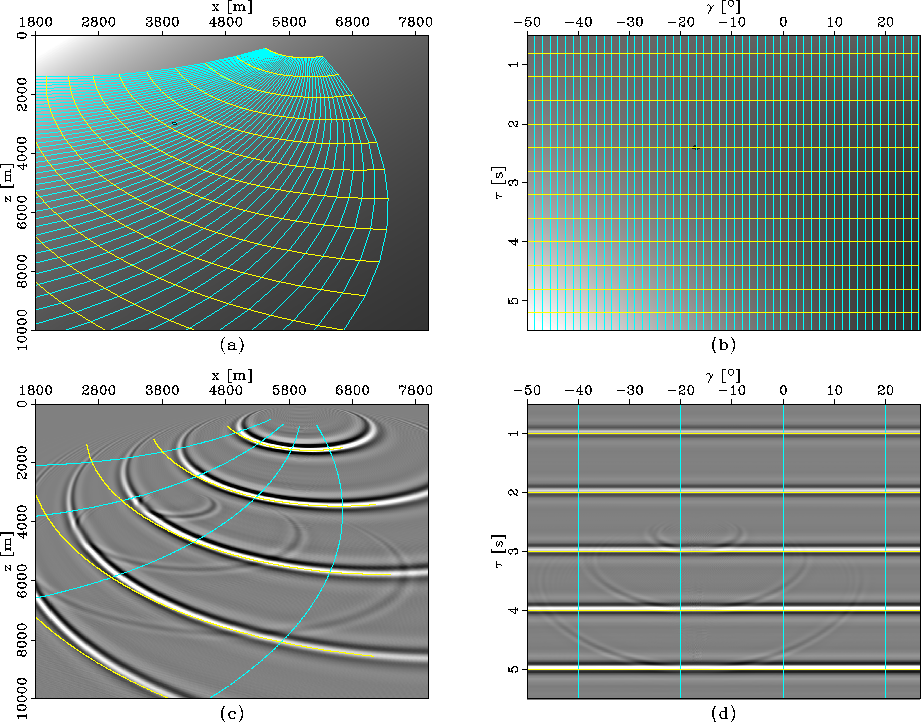 |
equation (c);
velocity model with an overlay of the
ray coordinate system (b);
image obtained by wavefield extrapolation in
ray coordinates with the
equation (d).


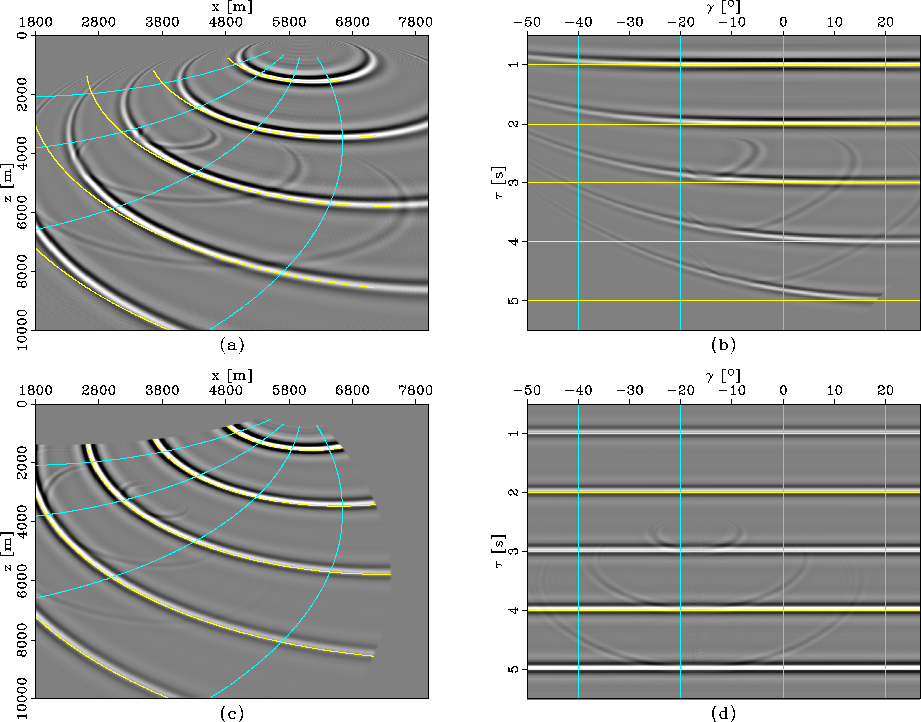 |
equation (a);
the image in panel (a) interpolated
to ray coordinates (b);
image obtained by extrapolation in
ray coordinates with the equation (d);
the image in panel (d) interpolated
to Cartesian coordinates (c).
We can also observe that the diffractions created by the anomaly in the velocity model are not at all limited in the ray coordinate domain. In a beam-type approach, such diffraction would not develop beyond the extent of the beam in which it arises. Neighboring extrapolation beams are completely insensitive to the velocity anomaly.
The second example is a smooth velocity with a negative Gaussian anomaly that creates a triplication of the ray coordinate system (RCga1.com.ps). Everything other than the velocity model is identical to its counterpart in the preceding example. Similarly to RCsi1.com.ps, panels (a) and (c) correspond to Cartesian coordinates, and panels (b) and (d) correspond to ray coordinates. Using regularization of the ray coordinates parameters, I extrapolate through the triplication. The discrepancy between the wavefields and the corresponding wavefronts highlight the decreasing accuracy in the caustic region caused by the parameter regularization.
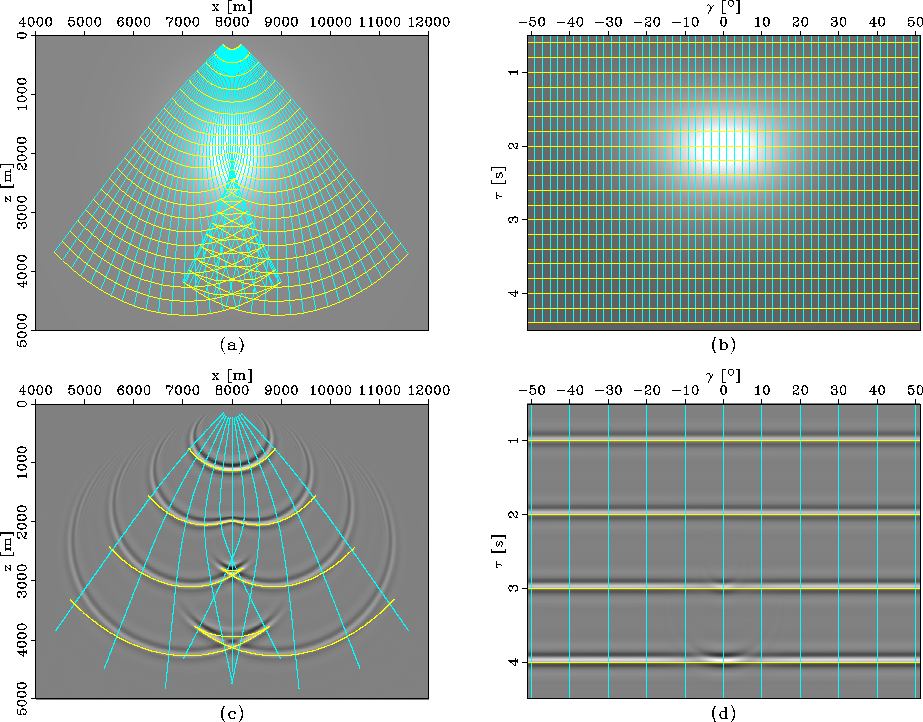 |
equation (c);
velocity model with an overlay of the
ray coordinate system (b);
image obtained by wavefield extrapolation in
ray coordinates with the
equation (d).
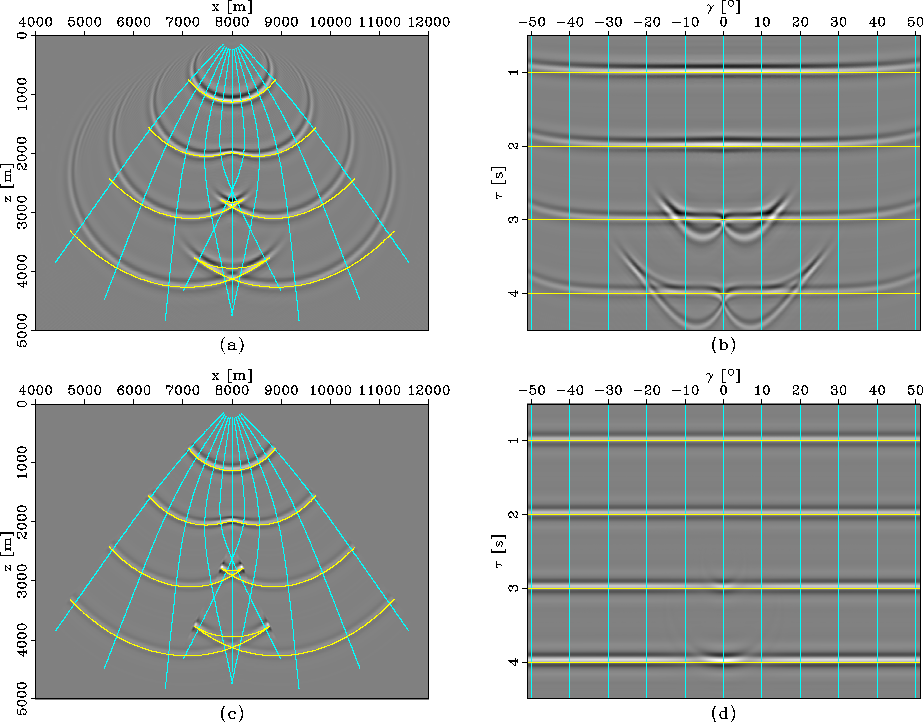 |
equation (a);
the image in panel (a) interpolated
to ray coordinates (b);
image obtained by extrapolation in
ray coordinates with the equation (d);
the image in panel (d) interpolated
to Cartesian coordinates (c).
The ``butterfly'' in RCga1.f15.ps (b)
is another indication that the ray coordinate system
is triplicating and that the
Cartesian coordinates are multi-valued
function of ray coordinates.
None of this happens when
I extrapolate in ray coordinates (d) and
interpolate to Cartesian coordinates (c)
since the mappings
and
are single-valued.
Comparing panels (a) and (c) of RCga1.f15.ps,
we can notice that the triplication tails at, for example,
 m and
m and  m extend farther
with the Cartesian extrapolator (a) than with the
Riemannian extrapolator (c).
The triplications create internal boundaries in the coordinate
system which are better avoided.
m extend farther
with the Cartesian extrapolator (a) than with the
Riemannian extrapolator (c).
The triplications create internal boundaries in the coordinate
system which are better avoided.
The next example uses the more complicated Marmousi
model. RCma4.com.ps shows
the velocity models mapped into the two
different domains, and the wavefields obtained
by extrapolation in each one of them.
I create the ray coordinate system by
ray tracing in a smooth version of the model,
and extrapolate in the rough version.
The source is located on the surface at  m.
m.
In this example, the wavefields triplicate in
both domains (RCma4.f15.ps).
Since I am using a equation,
extrapolation in Cartesian coordinates is only
accurate for the small incidence angles, as
observed in panels (a) and (b).
In contrast, extrapolating in ray coordinates
(d) does not have the same angular limitation,
which can be seen after mapping back to
Cartesian coordinates (c).
 |
equation (c);
velocity model with an overlay of the
ray coordinate system (b);
image obtained by wavefield extrapolation in
ray coordinates with the
equation (d).
 |
equation (a);
the image in panel (a) interpolated
to ray coordinates (b);
image obtained by extrapolation in
ray coordinates with the equation (d);
the image in panel (d) interpolated
to Cartesian coordinates (c).
 |
equation (b) and
the split-step equation (c);
image obtained using downward continuation
in Cartesian coordinates
with the  equation (d),
the equation (e) and the
split-step equation (f).
equation (d),
the equation (e) and the
split-step equation (f).
 |
equation (b) and
the split-step equation (c);
image obtained using downward continuation
in Cartesian coordinates
with the equation (d),
the equation (e) and the
split-step equation (f).
RCma4.zom.ps is a close-up
comparison of the wavefields obtained by
extrapolation with different methods in different
domains.
Panel (a) is a window of the velocity model for
reference. Panels (b) and (c) are obtained
by extrapolation in ray coordinates using
the and split-step equations, respectively.
Panels (d), (e) and (f) are obtained
by downward continuation in Cartesian coordinates
using the , and split-step
equations, respectively.
The ray-coordinate extrapolation results are similar
to the Cartesian coordinates results in the regions
where the wavefields propagate mostly vertically,
but are different in the regions where the
wavefields propagate almost horizontally.
RCma4.yom.ps is another close-up
comparison of the wavefields obtained by
extrapolation with different methods in different
domains. The panel structure is similar to the one
in RCma4.zom.ps.
This window is chosen to capture the portion of the wavefield
which is well described kinematically
by extrapolation in Cartesian coordinates
with the . We can observe that the amplitude
behavior of Riemannian extrapolation coincides with that
of Cartesian extrapolation.
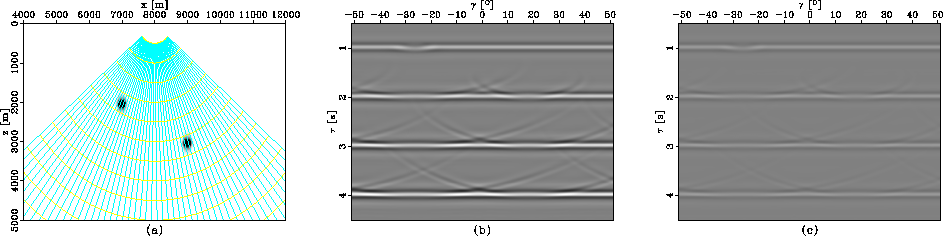
RCga2.kin.ps illustrates the difference between wavefield extrapolation using oneway.3d, panel (b) and wavefield extrapolation using oneway.3d.kinematic, panel (c). Kinematically, the two images are equivalent and the main changes are related to amplitudes. Panels (b) and (c) have the same clip to highlight the point that only the amplitudes change but not the kinematics.
 |
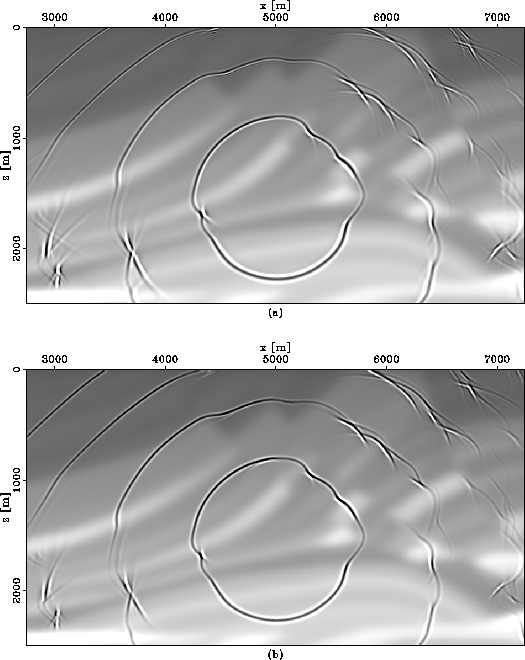
RCma2.fdm.ps shows a comparison between time domain acoustic finite-difference modeling (a), and Riemannian wavefield extrapolation (b) for a point source. The Marmousi velocity model is smoothed to avoid backscattered energy in panel (a) in order to facilitate a comparison with the one-way wavefield extrapolator in panel (b).
Despite being computed with a one-way extrapolator,
the wavefield in panel (b) captures accurately all the
important features of the reference wavefield
depicted in panel (a), including triplications and
amplitude variations.
Some of the diffractions in panel
(b) are not as well developed as their counterparts in
panel (a) due to the limited angular accuracy of the
approximation.
Regardless of accuracy, the computed
Riemannian wavefield could not be achieved
with Cartesian-based downward continuation.
 |
![[*]](http://sepwww.stanford.edu/latex2html/movie.gif)