Next: Discussion
Up: Angle-domain common image gathers
Previous: Regularization of the angle-domain
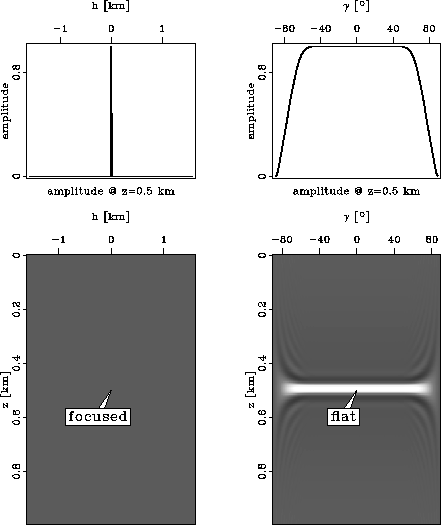
The first example represents a simple image-gather with one seismic
event perfectly focused at zero offset (simplesyn).
As expected, conversion to the angle-domain produces a flat event,
which fattens out at high angles due to the finite sampling of the
offset axis. This phenomenon is a consequence of the acquisition geometry,
and not a property of the conversion to the angle-domain.
The top panels of simplesyn show the amplitude of
this simple event as a function of offset (left) and as a function of
reflection angle (right).
The conversion to angle produces a flat amplitude curve,
as expected for this perfectly focused event.
If this event is produced using
true amplitude migration, then the reflectivity function of angle (AVA)
produced by this algorithm is also true amplitude.
simplesyn
Figure 3 Ideal offset-domain and angle-domain
common image gathers.


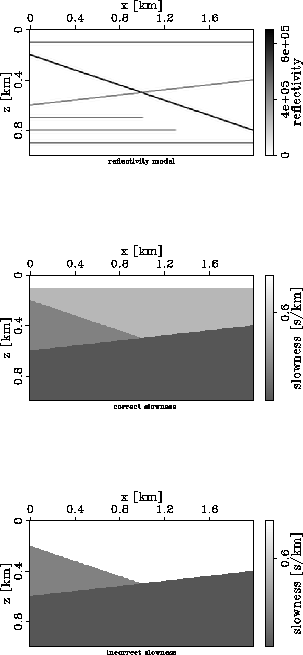
The second example is a 2D synthetic model with dipping reflectors
at various angles. I generate the synthetic data using wavefield-continuation
modeling and then image it using correct and incorrect velocities.
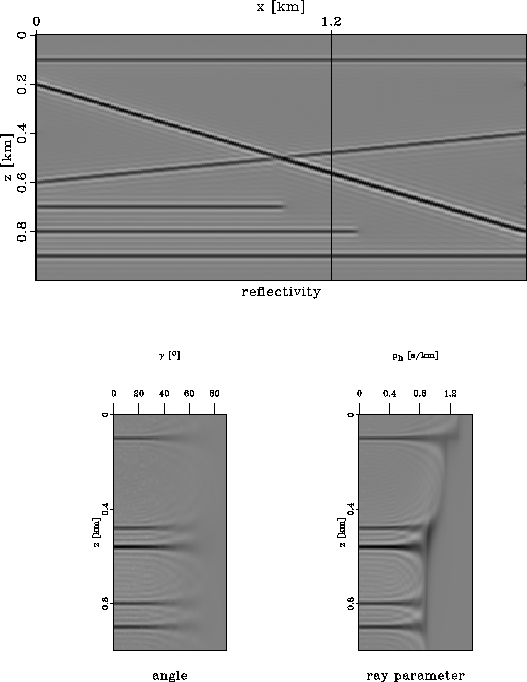
The ADCIGs are flat for the case of correct velocity (frcimgC),
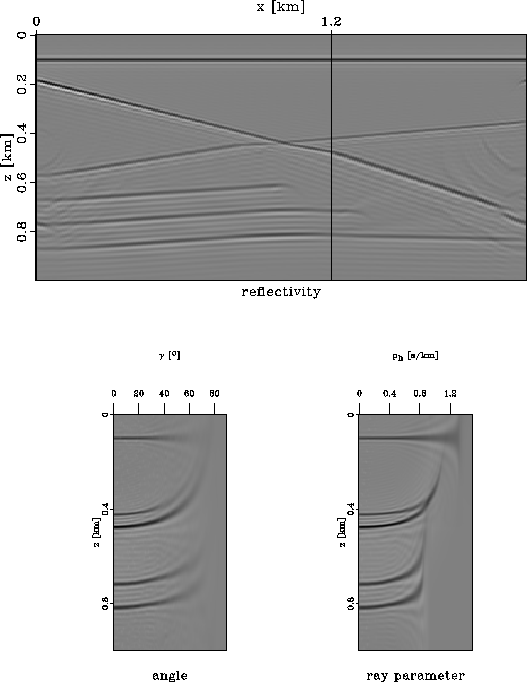
but they are not flat for the case of incorrect velocity (frcimg0).
The bottom panels show ADCIGs computed in the image and data spaces
at the location
indicated by the vertical line at 1.2 km.
The velocity changes in the upper part of the model from 1.75 km/s
in the correct model to 1.5 km/s in the incorrect one.
Since I have simulated wide offset data, the deeper flat events do not
suffer much from reduced angular coverage. However, the limited acquisition
causes a reduction in angular coverage for the
steeply dipping fault.
frcimgC and frcimg0 also show the different
amplitude behavior between the image space and data space methods: for the
image space method, the amplitudes decrease as a function of angle, while
for the data space method, the amplitudes increase as a function of
offset ray-parameter. This observation shows that AVA analysis on any of
the two kinds of angle gathers is problematic (91).
frcmodel
Figure 4 2D synthetic model: from top to bottom,
reflectivity model, correct and incorrect slownesses.
|
|  |
frcimgC
Figure 5
Synthetic model imaged using the correct velocity model:
section obtained by imaging at zero time and zero offset (top),
angle gather created in the image space (bottom left), and
angle gather created in the data space (bottom right).
frcimg0
Figure 6
Synthetic model imaged using the incorrect velocity model:
section obtained by imaging at zero time and zero offset (top),
angle gather created in the image space (bottom left), and
angle gather created in the data space (bottom right).
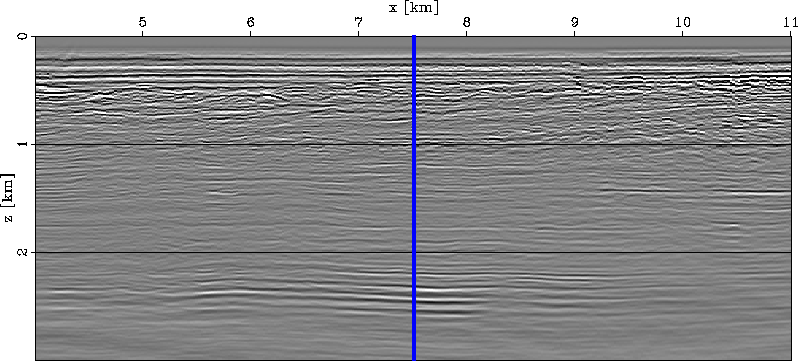
The third example concerns a real dataset acquired over a region with
fairly simple geology (kjamig).
This dataset was first analyzed by
(54)
and it is part of the SEP data library.
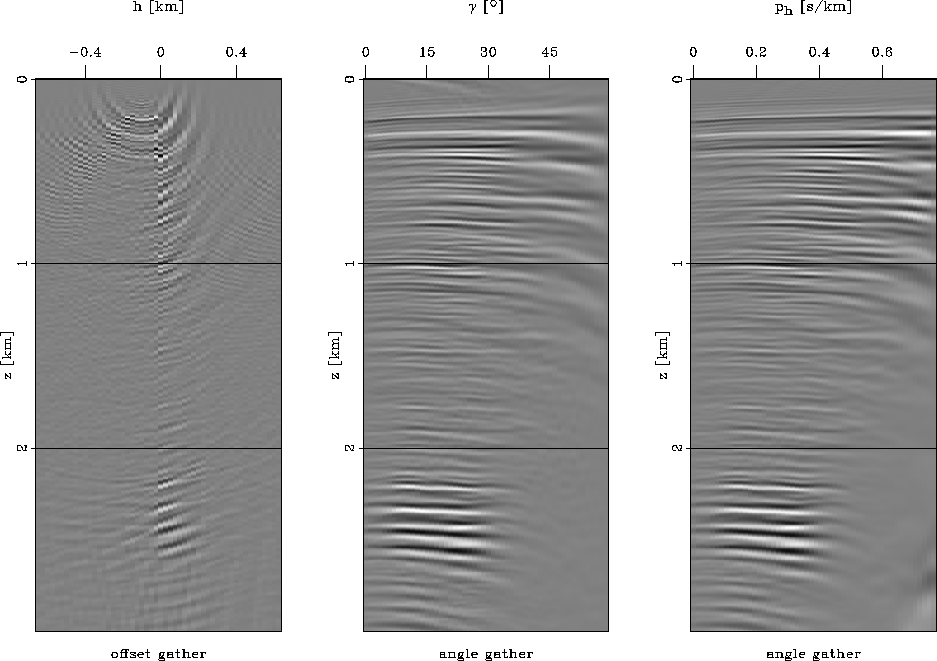
kjacig shows image gathers at x=7.5 km.
As theoretically predicted, at the imaging step most of the energy is
concentrated around zero offset.
After the conversion to the angle-domain, almost all the
events are flat, although some show slight moveout, indicating migration
and/or velocity inaccuracies. For this example, too, we can observe the
same difference in amplitude behavior of the data space versus the image space
method as for the synthetic example in
frcimgC and frcimg0.
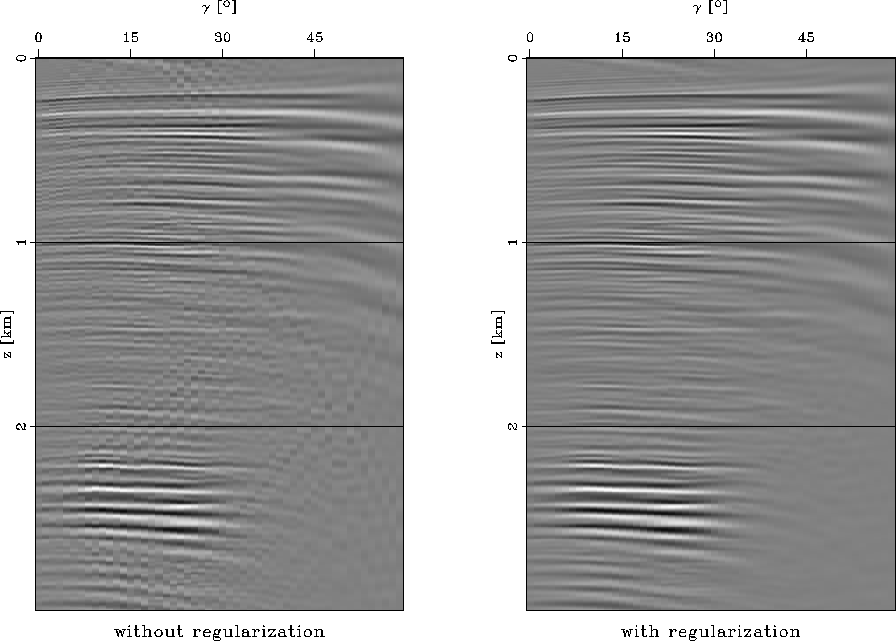
kjaeps demonstrates the effect of regularization in the
angle-domain. In the left panel, I present an angle gather created
without regularization ( ),
and on the right I present the same
angle gather obtained with regularization (
),
and on the right I present the same
angle gather obtained with regularization ( ),
according to LSsol. The left panel is
populated with artifacts caused by the non-uniform sampling of the ADCIG
due to the radial trace transform in the Fourier domain.
In contrast, the panel on the right shows fewer artifacts, which
makes the reflections much easier to interpret.
),
according to LSsol. The left panel is
populated with artifacts caused by the non-uniform sampling of the ADCIG
due to the radial trace transform in the Fourier domain.
In contrast, the panel on the right shows fewer artifacts, which
makes the reflections much easier to interpret.
kjamig
Figure 7 2D real data example: seismic section obtained
by imaging at zero time and zero offset.
kjacig
Figure 8 2D real data example: from left to right,
offset-gather (right panel) and angle gathers,
computed in the image-space (middle panel) and
the data-space (right panel)
kjaeps
Figure 9 2D real data example:
a comparison of an angle gather obtained without regularization (left)
and an angle gather obtained with regularization (right).
The fourth example concerns a 3D common-azimuth
(9) data set from the North Sea
(111).
This dataset was donated to SEP by Elf and it is part of the SEP
data library.
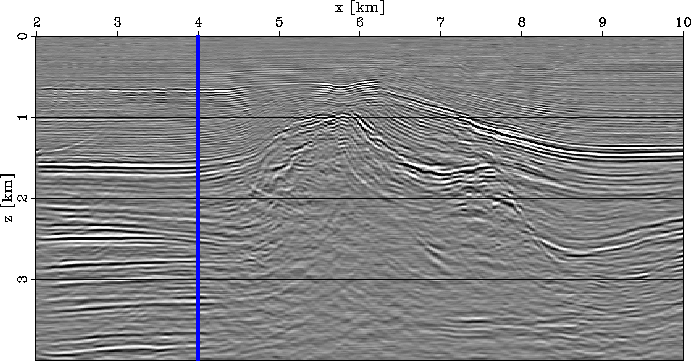
l7dmig is an inline extracted
from the 3D seismic cube and shows a salt body in the middle of the section,
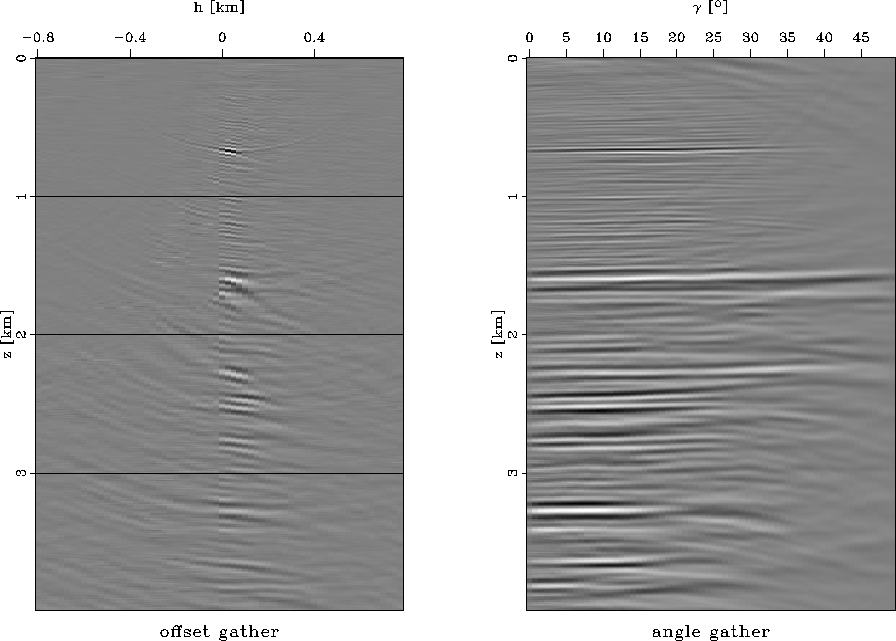
surrounded by fairly flat reflectors. l7dcig shows
an image gather at x=4.0 km, presented in the offset-domain (left panel)
and in the angle-domain (right panel).
As before, most of the energy is imaged around zero offset, which
translates in fairly flat events in the angle gather indicating that both
the migration and the velocity model are correct. The geometry of the
reflectors in this example are fairly simple, although the waves propagate
through a complicated salt area.
l7dmig
Figure 10 3D common-azimuth example:
seismic section obtained by imaging at zero time and zero offset.
The vertical line corresponds to the CIGs in l7dcig.
l7dcig
Figure 11 3D common-azimuth example:
offset-gather (left panel) and angle gather (right panel)
corresponding to the vertical line in l7dmig.
Next: Discussion
Up: Angle-domain common image gathers
Previous: Regularization of the angle-domain
Stanford Exploration Project
11/4/2004