


Next: Examples
Up: Prestack residual migration
Previous: Prestack Stolt residual migration
Common-azimuth data represent subsets of 3D prestack data that
have been recorded or transformed to a common azimuth,
which corresponds to zero cross-line offsets ( ).
Stolt migration for common-azimuth data involves
the use of the following dispersion relation (9):
).
Stolt migration for common-azimuth data involves
the use of the following dispersion relation (9):
|  |
(40) |
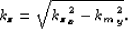
where the depth wavenumber for the common-azimuth dataset ( ) is
written as
) is
written as
|  |
(41) |
We can rewrite dispersion.true and disp.true
for a given reference velocity (v0) and obtain the corresponding depth
wavenumbers  and
and  .Mathematically, the goal of common-azimuth Stolt residual migrations
is also to obtain from .
Again, we can achieve this by eliminating the
frequency
.Mathematically, the goal of common-azimuth Stolt residual migrations
is also to obtain from .
Again, we can achieve this by eliminating the
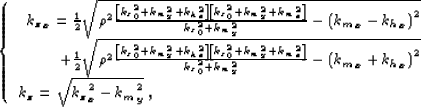
frequency  from the expressions for and ,
which leads to the 3D common-azimuth residual migration equations:
from the expressions for and ,
which leads to the 3D common-azimuth residual migration equations:
|  |
(42) |
where, by definition,  .If we make the change of variables
|  |
(43) |
we obtain a simplified version of myresmig-ca:
|  |
(44) |
For 2D data, where kmy=0,
 and
and  ,myresmig-ca reduce to the 2D prestack
myresmig-2d-pr and post-stack
myresmig-2d-po forms.
,myresmig-ca reduce to the 2D prestack
myresmig-2d-pr and post-stack
myresmig-2d-po forms.
Next: Examples
Up: Prestack residual migration
Previous: Prestack Stolt residual migration
Stanford Exploration Project
11/4/2004