Next: Diffraction-focusing WEMVA example
Up: Subsalt WEMVA examples
Previous: Normal incidence WEMVA
This section presents an example of wave-equation
migration velocity analysis applied to a 3D dataset from the
Gulf of Mexico (BP3d.sini - BP3Dx.77000).
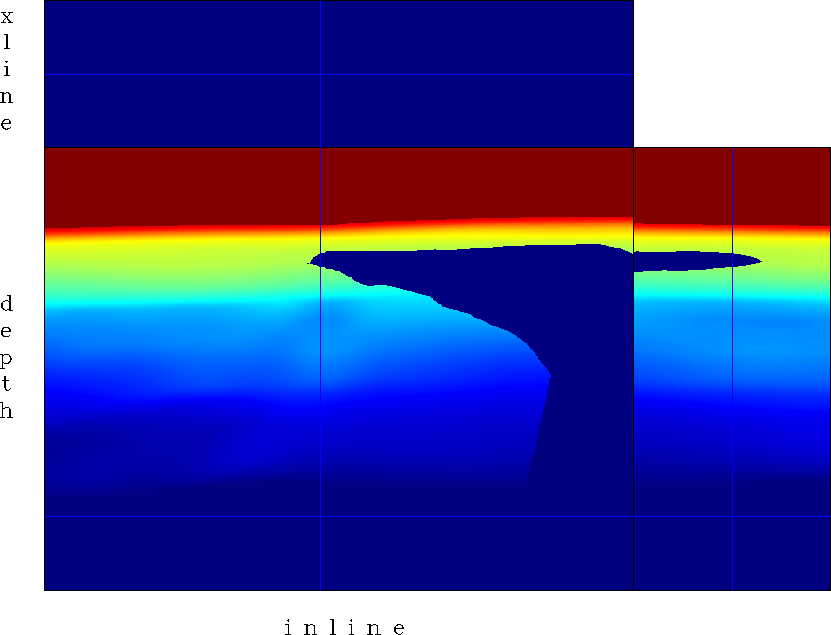
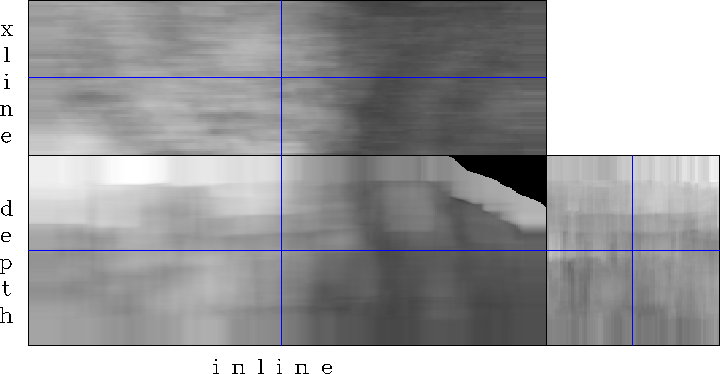
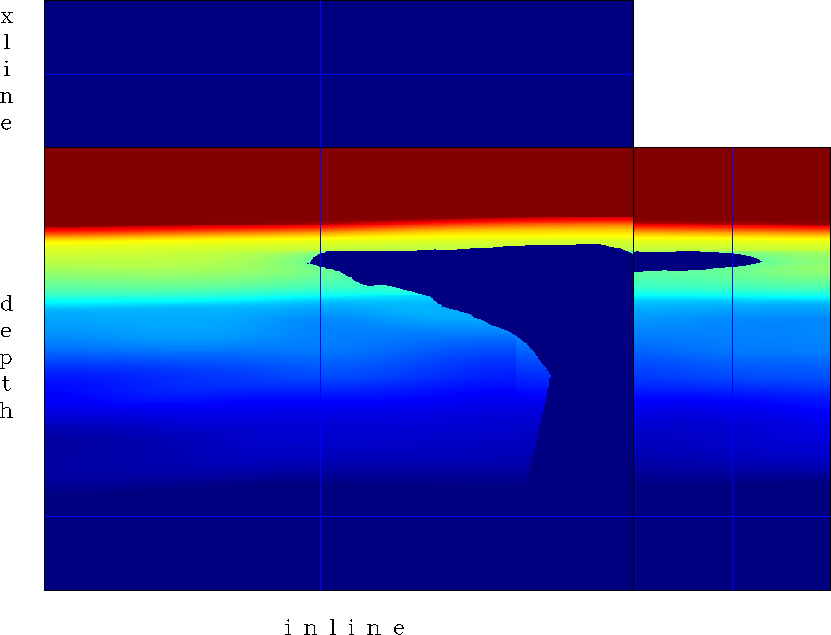
BP3d.sini shows the initial velocity model,
obtained after multiple iterations of traveltime tomography.
As for the preceding 2D example,
the model consists of a large overhanging salt body which
creates both complicated wave propagation and un-illuminated
regions subsalt.
Both phenomena reduce the ability of traveltime tomography to
properly describe wavepaths subsalt, which leads to
less accurate velocities in the complicated areas with
multipathing and shadows.
An example is illustrated along the inline
direction in BP3d.sini, approximately at the location
of the vertical line.
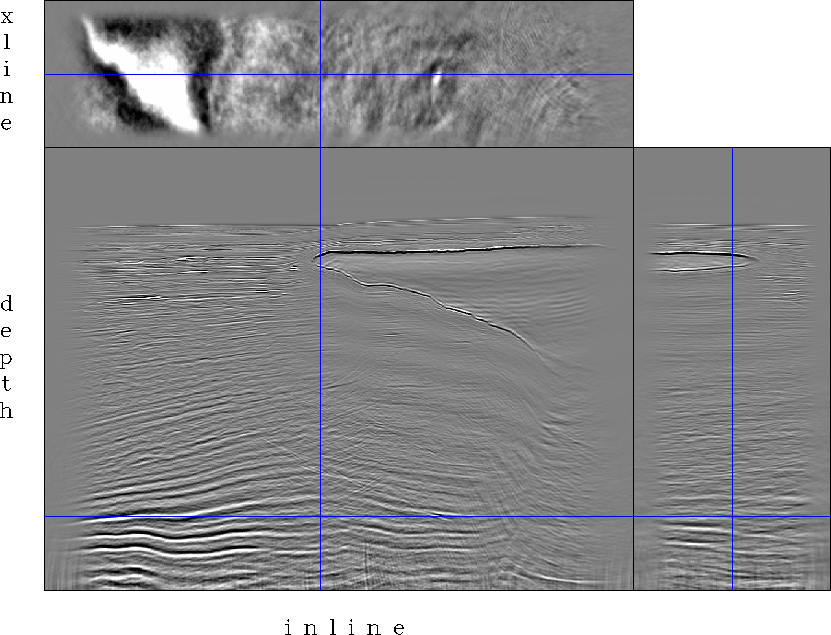
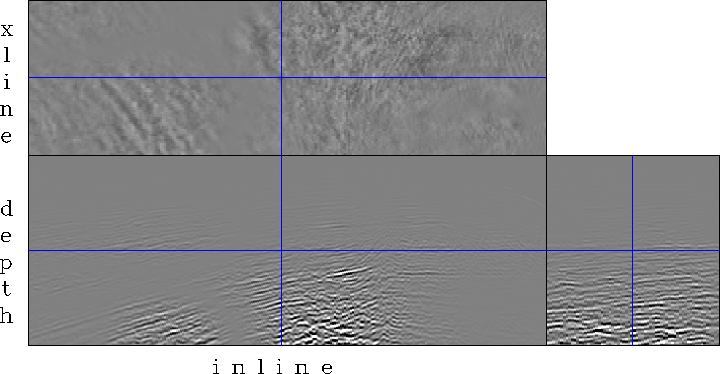
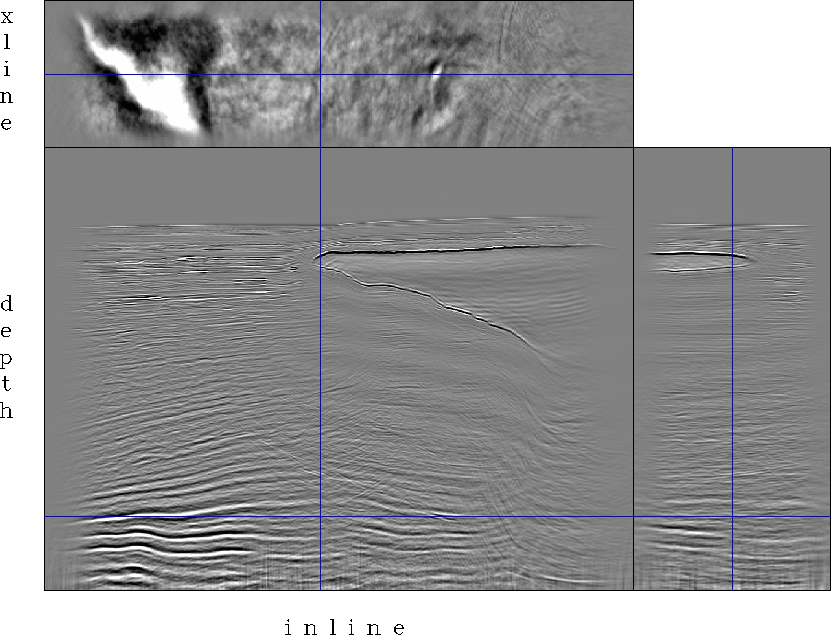
BP3d.pini shows the image corresponding to the
model in BP3d.sini.
For cost reasons, in this example I do not use the entire
image. I concentrate my attention on the small anomalies
located right under the salt nose as pictured in
BP3d.sini.
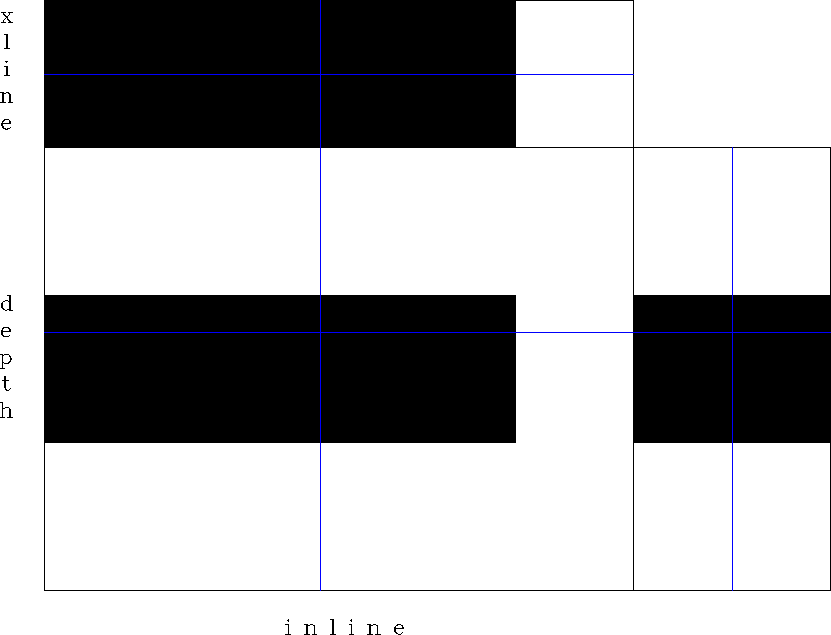
BP3d.mask indicates the portion of the image/velocity
used for this analysis. I use this part of the starting
(background) image to generate the wavefield
corresponding to the initial (background) velocity.
Then, I run normal-incidence WEMVA as discussed in
wemva.
BP3d.sini
Figure 22 3D Gulf of Mexico example.
Initial slowness model. Compare with BP3d.smix2.


 BP3d.pini
Figure 23 3D Gulf of Mexico example.
Initial image. Compare with BP3d.pmix2.
BP3d.mask
Figure 24 3D Gulf of Mexico example.
Box selected for WEMVA.
The first step in WEMVA is to generate an image perturbation.
For this, I run prestack residual migration starting from the
background image pictured in BP3d.pini.
The velocity ratios I use are between 0.92 and 1.07.
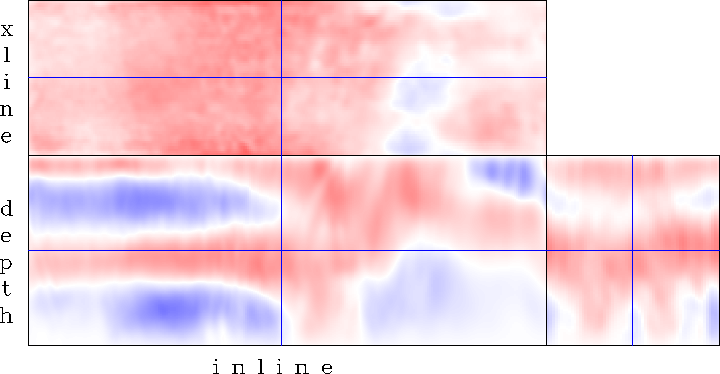
BP3d.dro shows the picked velocity ratio that
optimizes angle gather flatness at every location in the 3D image.
BP3d.www is the associated weight quantifying the
reliability of the picks in BP3d.dro.
The brighter colors indicate higher reliability than the
darker ones. The subsalt picks are less reliable than those
in the sedimentary region away from the salt.
BP3d.dro
Figure 25 3D Gulf of Mexico example.
Velocity ratio perturbation picked after residual migration.
BP3d.www
Figure 26 3D Gulf of Mexico example.
Data residual weight.
Based on the background image in BP3d.pini
and the picks in BP3d.dro, I construct the image
perturbation in BP3d.dia. As indicated earlier,
this image perturbation corresponds to normal incidence,
although it incorporates moveout/focusing information
extracted from prestack residual migration.
After 25 linear iterations of WEMVA,
I obtain the slowness perturbation in BP3d.isx.
I use preconditioned regularized inversion (22),
where for regularization I use an isotropic Laplacian operator.
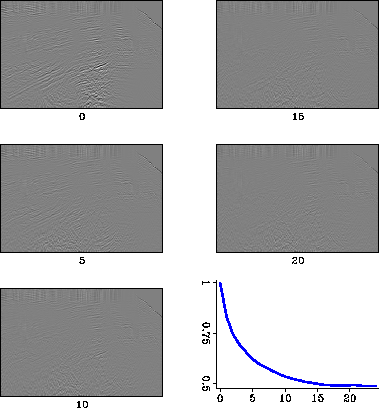
BP3d.datres shows the data residual at a fixed
crossline, function of iterations. The number
associated with each panel indicates the iteration
number. We can observe that the data residual is
decreasing in absolute magnitude and that it becomes
less structured function of iterations.
The plot in the lower-right panel shows the
absolute magnitude of the data residual
monotonically decaying function of iterations,
indicating that the conjugate gradient procedure
is converging.
BP3d.dia
Figure 27 3D Gulf of Mexico example.
Image perturbation.
BP3d.isx
Figure 28 3D Gulf of Mexico example.
Slowness perturbation.
BP3d.datres
Figure 29 3D Gulf of Mexico example.
Data residual function of iterations.
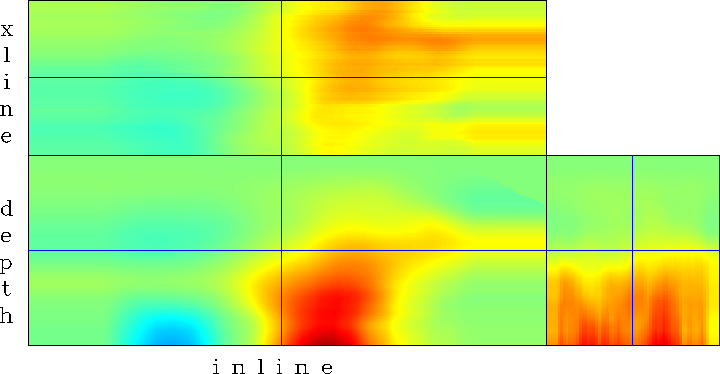
Next, I update the background slowness model by
adding a smooth version of the computed perturbation
to the background velocity.
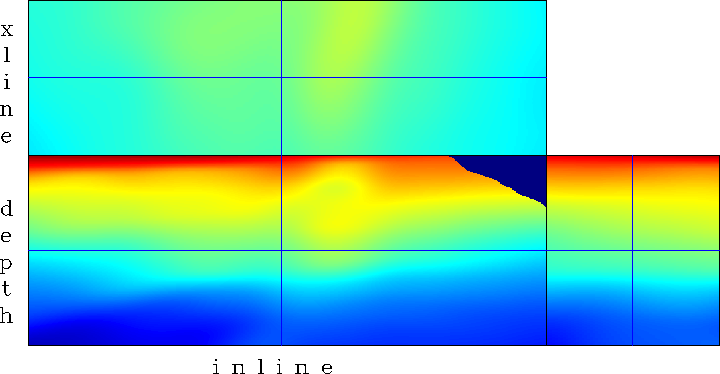
BP3d.wso shows the initial slowness inside
the box used for WEMVA. For comparison,
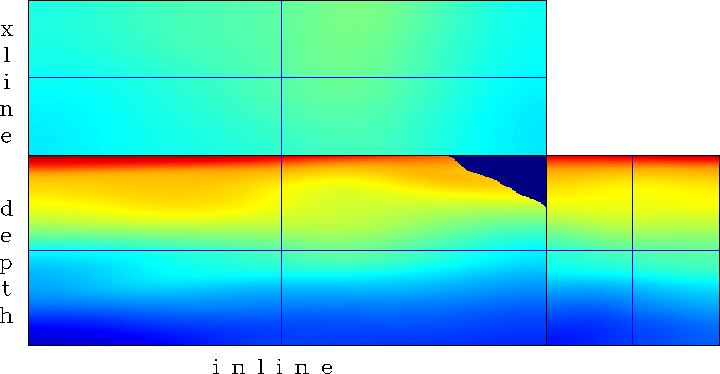
BP3d.wsz shows the updates slowness model
in the same region. The most obvious observation we can make
is that the anomalies associated with the shadow zones
corresponding to the salt body are reduced, although
the general trends of the slowness model remain the same.
This is not a surprise, since the starting model is already
a good model which does not need much updating.
BP3d.wso
Figure 30 3D Gulf of Mexico example.
Initial slowness model in the inversion box. Compare with BP3d.wsz.
BP3d.wsz
Figure 31 3D Gulf of Mexico example.
Updated slowness model in the inversion box. Compare with BP3d.wso.
BP3d.smix2 shows the slowness obtained
by embedding the slowness from the inversion box in the
initial slowness. This process is not ideal, since it
may create velocity discontinuities that need to be
smoothed-out.
The model in BP3d.smix2 needed such smoothing
under salt, close to the vertical salt pillar.
BP3d.pmix2 shows the updated image obtained by
migration with the slowness in BP3d.smix2.
BP3d.smix2
Figure 32 3D Gulf of Mexico example.
Updated slowness model. Compare with BP3d.sini.
BP3d.pmix2
Figure 33 3D Gulf of Mexico example.
Updated image. Compare with BP3d.pini.
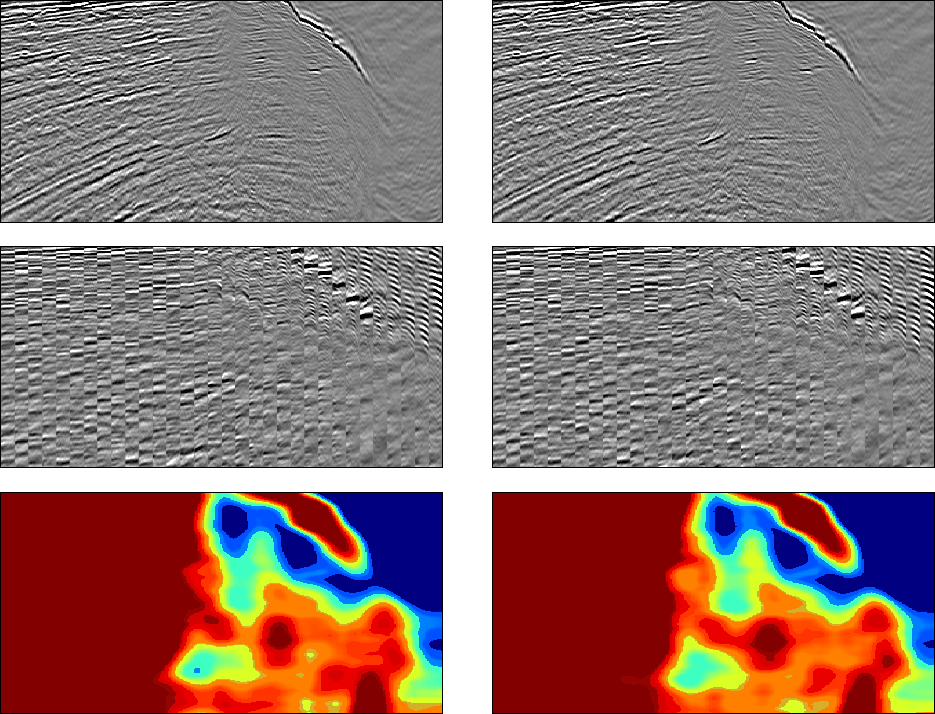
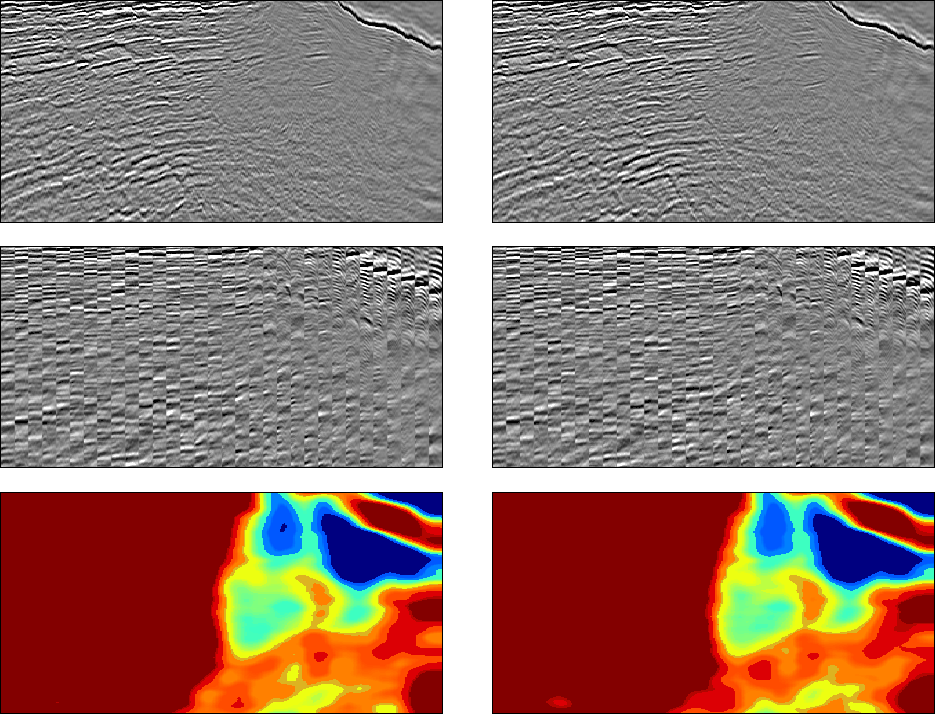
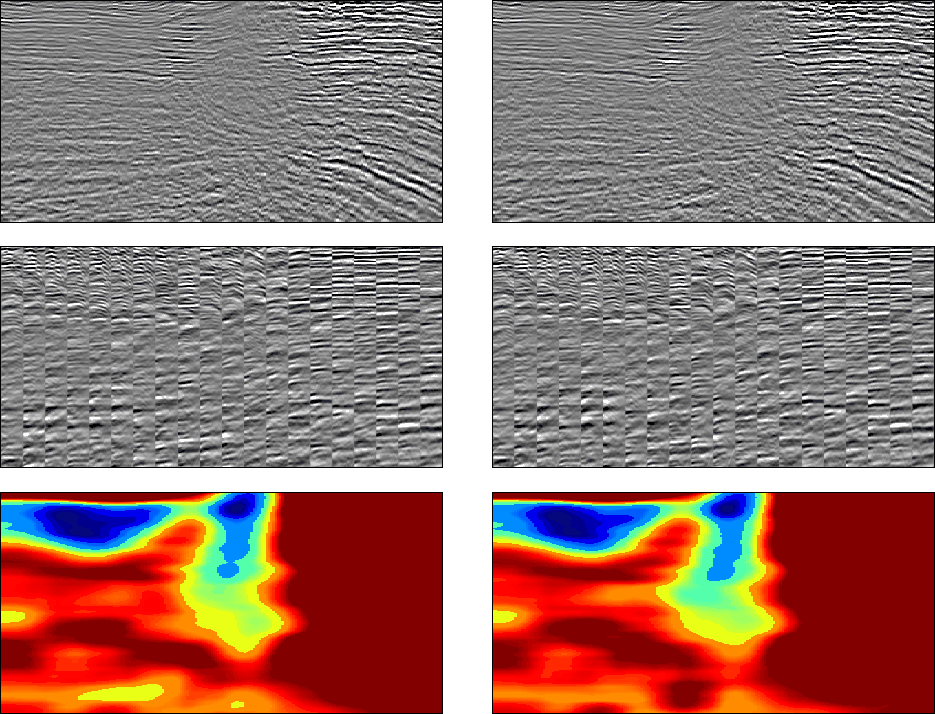
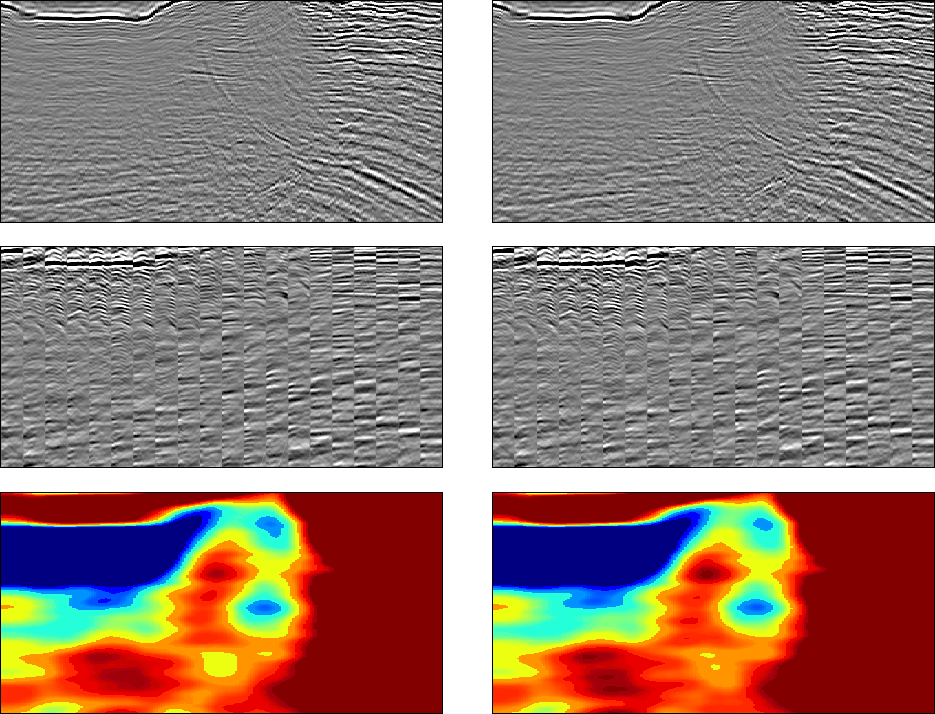
Finally, BP3Di.70700 to BP3Dx.77000 show
two inlines and two crosslines taken from the prestack
image obtained by migration of the 3D prestack data with
the initial and updated slowness model.
From top to bottom, the panels correspond to the migrated
image, a few angle gathers taken at equally spaced locations,
and the semblance map computed on the angle gathers around
the horizontal direction.
Since the initial and the updated velocity models are close
to one-another, there are no large changes in the image.
Most of the changes are marginal, and cannot be properly
displayed without ``before-after'' movies.
Slight increases in semblance are visible, mostly under
the salt indicating better velocity and flatter gathers.
Of course, since the starting model is very close to the
correct one, not everything in the image improves. There
are portions where the semblance actually decreases.
However, the overall image quality measured by semblance
increases slightly.
BP3Di.70700
Figure 34 3D Gulf of Mexico example.
Inline comparison of initial (left) and final (right) models.
Image stack (top), angle gathers (middle) and image semblance (bottom).
![[*]](http://sepwww.stanford.edu/latex2html/movie.gif) BP3Di.77426
BP3Di.77426
Figure 35 3D Gulf of Mexico example.
Inline comparison of initial (left) and final (right) models.
Image stack (top), angle gathers (middle) and image semblance (bottom).
BP3Dx.74000
Figure 36 3D Gulf of Mexico example.
Crossline comparison of initial (left) and final (right) models.
Image stack (top), angle gathers (middle) and image semblance (bottom).
BP3Dx.77000
Figure 37 3D Gulf of Mexico example.
Crossline comparison of initial (left) and final (right) models.
Image stack (top), angle gathers (middle) and image semblance (bottom).
Next: Diffraction-focusing WEMVA example
Up: Subsalt WEMVA examples
Previous: Normal incidence WEMVA
Stanford Exploration Project
11/4/2004