


Next: Wave-equation migration velocity analysis
Up: Angle-domain common image gathers
Previous: Angle-domain common image gathers
This appendix shows the derivation of freq, which
serves as the basis of the frequency-domain
angle gather construction (adcig).
In the process of downward continuation, the wavefield appears as a
function of four variables: time t, depth z, source lateral
position s, and receiver lateral position r. Both the source and
receiver assume positions at depth z, where the wavefield is
continued (24). It is often convenient to
replace the variables s and r with the midpoint position x =
(s+r)/2 and the half-offset h = (r-s)/2.
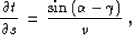
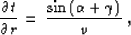
Assuming that the reflection event in the continued wavefield is
described by the function t = t(z,s,r), we find from the Snell's law
the following derivatives:
|  |
(85) |
|  |
(86) |
where v is the wave velocity,  is the dip angle, and
 is the reflection angle (local).
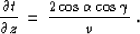
The traveltime derivative with respect to the depth of the
observation surface z has contributions from the two branches
of the reflected ray, as follows:
is the reflection angle (local).
The traveltime derivative with respect to the depth of the
observation surface z has contributions from the two branches
of the reflected ray, as follows:
|  |
(87) |
snell3 corresponds to the well-known
double-square-root equation (24).
This equation simply reflects the fact that the traveltime
increases with increasing depth of the reflector.
Transforming snell1-snell3
to the midpoint and half-offset coordinates, we obtain
|  |
(88) |
|  |
(89) |
|  |
(90) |
At a fixed image location x,
we can transform the derivatives of t(z,x,h) to the derivatives of
z(t,x,h) by applying the implicit function theorem.
Using snells2-snells3, we obtain
|  |
(91) |
snellz2 corresponds to freq
in the adcig.
It is important to note that this equation
is only suitable for angle gathers constructed on images
obtained by wavefield continuation methods (local),
when h does not represent the surface offset, but half the distance
between the downward continued sources and receivers.
In deriving snellz2, I assumed that the
velocity v does not change laterally between the source and receiver
positions. While this may not be true in general,
snellz2 is always satisfied in the vicinity
of zero half-offset after migration (h=0).
Therefore, this formula is applicable near the focusing
points of the downward-continued wavefield.
Next: Wave-equation migration velocity analysis
Up: Angle-domain common image gathers
Previous: Angle-domain common image gathers
Stanford Exploration Project
11/4/2004