


![[pdf]](icons/pdf.png)
|
|
|
|
| Reverse Time Migration of up and down going signal for ocean bottom data | |
|
The goals of our joint inversion scheme are threefold:
 )and vertical particle velocity (
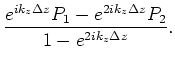 ). To make use of the measurement, we would need to apply elastic modeling. Our proposed joint inversion scheme will avoid this difficulty.
|
|---|
|
Flowchart2
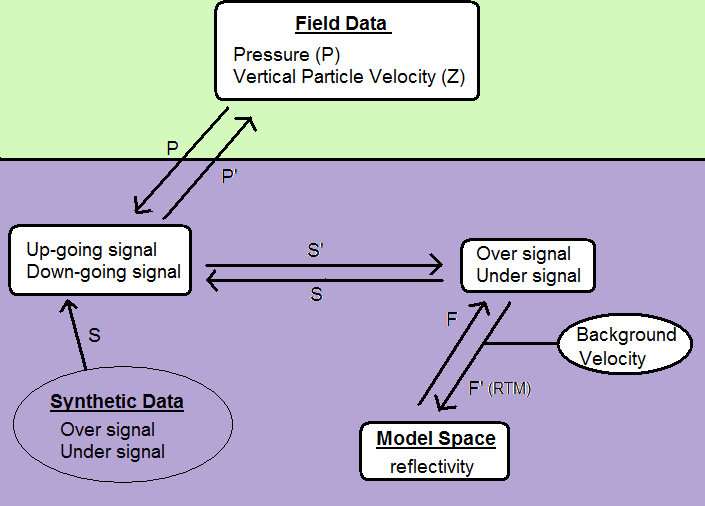
Figure 6. This flowchart shows the relationship between multi-component pressure (P) and vertical particle velocity (Z) data, up- and down-going data, and over/under data. Reverse time migration (RTM) is performed with over/undre data and generate reflectivity in migration using a background velocity model. [NR] |
|
|
Our proposed scheme can be summarized using the flowchart in Figure 6. Field data  and
and  can be converted into up-going and down-going data at the receiver level by applying the PZ summation operator
  . There are many ways to implement PZ summation; one of the simplest is described in Wong et al. (2009).
![$\displaystyle \left[ \begin{array}{c}
\tilde{d_{\uparrow}} \\
\tilde{d_{\downa...
...right] = \bold P \left[ \begin{array}{c}
d_{P} \\
d_{Z}
\end{array} \right].
$](img56.png)
Next, up- and down-going data can be converted into over- and under- data using the adjoint of the separation operator 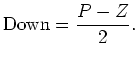 :
:
![$\displaystyle \left[ \begin{array}{c}
\tilde{d_{o}} \\
\tilde{d_{u}}
\end{arra...
...rray}{c}
\tilde{d_{\uparrow}} \\
\tilde{d_{\downarrow}}
\end{array} \right].
$](img57.png)
RTM is performed using over and under data via the RTM operator, denoted as 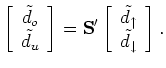 :
:
![$\displaystyle \bold m = \bold F' \left[ \begin{array}{c}
\tilde{d_{o}} \\
\tilde{d_{u}}
\end{array} \right].
$](img59.png)
Since all three operators are linear, we can do acoustic RTM on 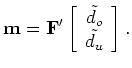 and by applying a cascade of these operators, denoted as
  :
:
![$\displaystyle \bold m = \bold F' \bold S' \bold P \left[ \begin{array}{c}
\tild...
... \left[ \begin{array}{c}
\tilde{d_{P}} \\
\tilde{d_{Z}}
\end{array} \right].
$](img62.png)
We claim that by applying the inverse operator
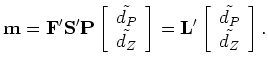 instead of the adjoint operator , the three goals discussed at the beginning of the section can be achieved. The testing of this theory is the focus of our current research.
|
|
|
|
| Reverse Time Migration of up and down going signal for ocean bottom data | |
|