


Next: COMPUTATION OF ADJOINT OPERATORS
Up: VELOCITY ANALYSIS
Previous: VELOCITY ANALYSIS
Equations (6) and (7) usually contain an enormous number
of variables and, as will be shown later, are extremely ill-conditioned.
However,
good results may be obtained in a small number of iterations if a conjugate gradient
method is used.
To solve the equation
|  |
(8) |
we can minimize the function
|  |
(9) |
or for stochastic inversion,
| 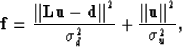 |
(10) |
where  and
and  are the variances of the data and
the model spaces respectively.
are the variances of the data and
the model spaces respectively.
When a velocity analysis panel is obtained by the solution of equation (6) or
equation (7), an inversion is easily done by application of
the operator  or
or  on the velocity analysis
panel
on the velocity analysis
panel  .
.
We can also consider solving the equation
|  |
(11) |
where was obtained by the application of  on (t,x)-space, and
|  |
(12) |
where was obtained by the application of  on
(t,x)-space.
on
(t,x)-space.
Next: COMPUTATION OF ADJOINT OPERATORS
Up: VELOCITY ANALYSIS
Previous: VELOCITY ANALYSIS
Stanford Exploration Project
1/13/1998