


As a result, an impulse in a constant offset section will be moved
in a zero offset section accounting also for the effect of the
dipping reflector.
The element which fixes the position of the migrated point on the ellipse is
the dipping angle  . The coordinates of the points on the ellipse are
functions of the dip angle .
. The coordinates of the points on the ellipse are
functions of the dip angle .
The mapping of the input point (th,xh) from a constant offset section into the point (t0,x0) in a zero-offset section can be expressed as


Given the geometry in Figure 1, the coordinates of the point P can be
expressed as a function of the semiaxes of
the ellipse (a and b ) and the dip angle .The semiaxis are a = thV and b
 , where V is half the earth velocity.
The equation of the ellipse is:
, where V is half the earth velocity.
The equation of the ellipse is:
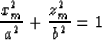 |
(1) |
z2ma2 = a2b2 - x2mb2
The equation of the tangent to the ellipse is  where
where
 and
and  .
.
 |
(2) |
Squaring equation 2 and multiplying both sides with  we obtain:

 |
(3) |
 |
(4) |
From the previous equation (4) we obtain the value for xm, and introducing this value in equation 1, we obtain zm.
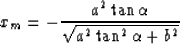 |
(5) |
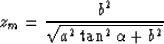 |
(6) |
Each point on the ellipse corresponding to a
certain parameter (dipping angle), can be considered a point
diffractor and therefore generate a hyperbola.
For a zero-offset section the point will be
situated on the modeling hyperbola with the following coordinates:
 |
(7) |
 |
(8) |
Inserting equations (5,6) in (7,8) we obtain:
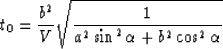 |
(9) |
 |
(10) |
)of the well known DMO ellipse.
In the end the DMO operator contoured for only half space will look like in Figure 3. We demonstrate in Appendix A that the operator follows the envelope of the hyperbolas.