


Next: About this document ...
Up: References
Previous: References
The impulse response of the DMO operator is the envelope to the
family of hyperbolas obtained by considering each point on the
migration ellipse, a point diffractor. This is a rather peculiar
property of the DMO operator and we determine here the
equation of the envelope of the hyperbolas, which
coincides with the DMO operator. While the equation of the envelope is
the equation of an ellipse with the horizontal semiaxis equal with
the offset, the impulse response of the DMO is only a part of the
total ellipse, the maximum x coordinate being

; where h is the offset and a is the
semiaxis of the full constant offset migration ellipse

.
The equation of the family of hyperbolas in Fig.A.1 is:
|
z2 = zm2 + (xm - x)2
|
(11) |
The points of coordinates (xm,zm) are situated on the ellipse,
representing a parametrized form of the ellipse equation.
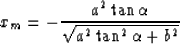
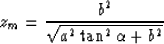
In expanded form the function F(x,z,t) where  will be:
|  |
(12) |
The envelope of the family of curves represented in equation ?? is
obtained by eliminating the parameter  from the two equations:
F(x,z,t)=0
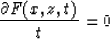
We have then the equations:
|  |
(13) |
|  |
(14) |

Which gives for :

| 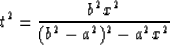 |
(15) |
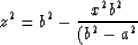
Introducing in ?? we obtain:
|  |
(16) |
Because  and
and  represent the semiaxis of the ellipse,
the offset
represent the semiaxis of the ellipse,
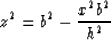
the offset  is given by h2 = a2 - b2. The equation
?? can be rewritten as:
is given by h2 = a2 - b2. The equation
?? can be rewritten as:
|  |
(17) |

The equation of the envelope is the equation of an ellipse, with
the vertical semiaxis equal to and the horizontal semiaxis
equal to the offset .As the depth z is given by

and the
semiaxis b is given by

where
tn
is
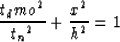
the time impusle after the NMO correction, we can rewrite the
equation as
|  |
(18) |
which is the well known equation of the full DMO ellipse.
Next: About this document ...
Up: References
Previous: References
Stanford Exploration Project
1/13/1998