


 |
(6) |
 represent
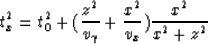
  .But in this case, can be replaced by the more physically meaningful parameter, vq, which is the velocity at 45 degrees. By using vq, we can formulate the moveout equation as follows:
 |
(7) |

 |
(8) |
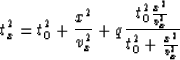
In both approximations, q represents the anelliptic factor and set equal to zero gives hyperbolic moveout equation. In the case of Byun's approximation, the anelliptic factor, q or vq, directly represents the deviated velocity from the ellipse or the velocity at 45 degrees, respectively. In the case of Muir's approach, the unit of q has no dimension, and the magnitude is controlled by the ratio of horizontal velocity to vertical velocity.
From a practical point of view, Muir's method is superior because it can be used for surface common midpoint gather data by fixing time for some event and applying semblance analysis as a function of q and vx. Byun's approach requires one more parameter, vz, to calculate moveout. For a given event, therefore, semblance analysis can be performed by scanning over ranges of the three parameters, vz,vx and vq. If the average vertical velocity vz is known, as may the case from VSP or check-shot data, then the semblance scan can be done over the two parameters, vx and vq.