


We shall write  if f(r)(t) is continuous (that is,
  ).
If
).
If  then
then  . (It
is not necessary that each of the functions f1 and f2 belongs to
. (It
is not necessary that each of the functions f1 and f2 belongs to
 ).
We don't distinguish functions whose difference is a smooth function.
Each continuous function is equivalent (of order r=0) to 0
and each polynomial Pn(t) is equivalent to 0 with the order
).
We don't distinguish functions whose difference is a smooth function.
Each continuous function is equivalent (of order r=0) to 0
and each polynomial Pn(t) is equivalent to 0 with the order  .
.
 (r=0,1,2,...) but
  . We may introduce the order r=-1 and write
  .
.  |
(8) |
 |
(9) |
 and
and  .
.
Is it true that  The answer is: yes. Is it true that
  The answer is: no, however
 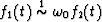 .(It easily may be derived that
  has a continuous
derivative at the point t=0).
has a continuous
derivative at the point t=0).