


In addition to the basic  and
and  classes,
there are also classes that define arrays of each. A
``
classes,
there are also classes that define arrays of each. A
`` '' is a two dimensional array of
  , which are
not necessarily conformable with each other. An operator array is also
a two dimensional array which contains operators. Applying a
, which are
not necessarily conformable with each other. An operator array is also
a two dimensional array which contains operators. Applying a  to a :

 ,
,  , and
, and  are two dimensional arrays (of operators or spaces.)

 and
and  must be compatible. Also the results to be summed must be
compatible, the space that results from
must be compatible. Also the results to be summed must be
compatible, the space that results from  must be compatible with the space that results from
  .
.In C++, this looks like:
<type>spacearray u = B.Forward(v);This is almost identical to the syntax for applying a single operator to a single space, except here the variables u and v are of class
and the operator B is of class
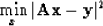
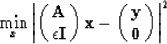
.A simple example of using arrays is to generate a damped operator from the regular operator. If we wish to calculate the damped solution to the problem
 |
(1) |
The new operator,  can be written
as
can be written
as

 it gives a space-array,
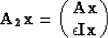

class.
The following routine gives the damped least squares solution to
any linear problem that can be posed in terms of opa,
an instance of the class ,and a RHS, y, of the class .
// This routine gives a damped solution to the least squares problem
// opa.Forward( x ) = y;
// by augmenting the operator with a diagonal damping matrix

<type>space damped_solver( <type>space& x0,   // initial solution
                           <type>op opa,      // linear operator
                           <type>space& y,    // rhs
                           float epsilon,     // the damping factor
                           int maxiter )      // maximum no. of iterations
{
  <type>oparray ops(2);            // declare a 2x1 operator array
  <type>Scale   scale( epsilon );  // scale is a diagonal scaling operator
  ops(1) = &opa; ops(2) = &scale; // assign the elements of the operator array

  <type>spacearray rhs(2)          // declare a 2x1 rhs array of spaces.
  <type>space zero = x.empty()     // zero is the same shape as x but all zeros.
  rhs(1) = y; rhs(2)=zero         // assign the elements of the rhs

  // now solve the augmented problem, and return the result
  return <type>space soln = <type>arraysolver( x0, ops, rhs, maxiter );

}
The new operator ops ( of class ) and right hand side,
rhs ( of class ) are used to solve the
damped least squares problem. This is done by the routine
 , which is one of a family of solver routines
that are available.
, which is one of a family of solver routines
that are available.