


![[*]](http://sepwww.stanford.edu/latex2html/cross_ref_motif.gif) ,
the reflection amplitudes produced by our
modeling scheme are in nearly perfect agreement with analytical solutions
to the reflection amplitudes.
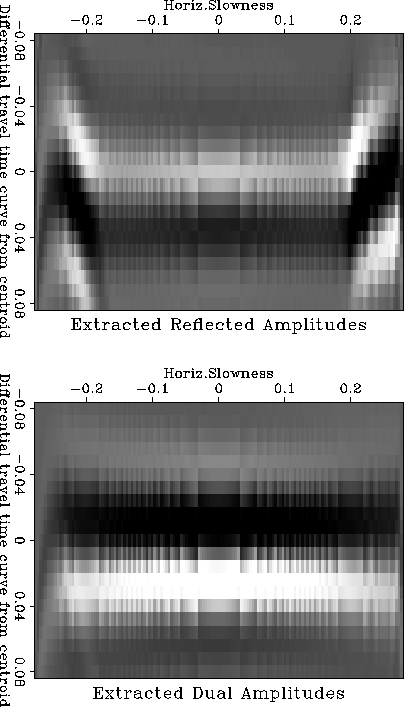
Figures and show
the analytically calculated responses compared with the modeled extracted responses.
,
the reflection amplitudes produced by our
modeling scheme are in nearly perfect agreement with analytical solutions
to the reflection amplitudes.
Figures and show
the analytically calculated responses compared with the modeled extracted responses.
|
ppcalibrate
Figure 2 PP calibration curve for the FD modeling response. Reflection amplitudes were extracted using the dual experiment. Zoeppritz plane-wave energy reflection coefficients are calculated analytically. | 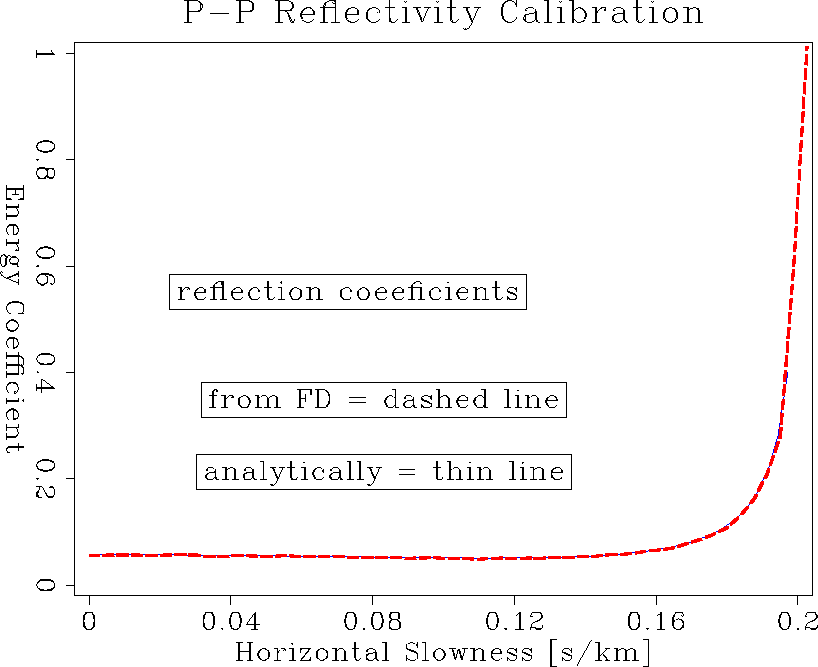 |

|
iso1.ref
Figure 3 Analytically calculated energy reflection and transmission coefficients from Zoeppritz equations. | 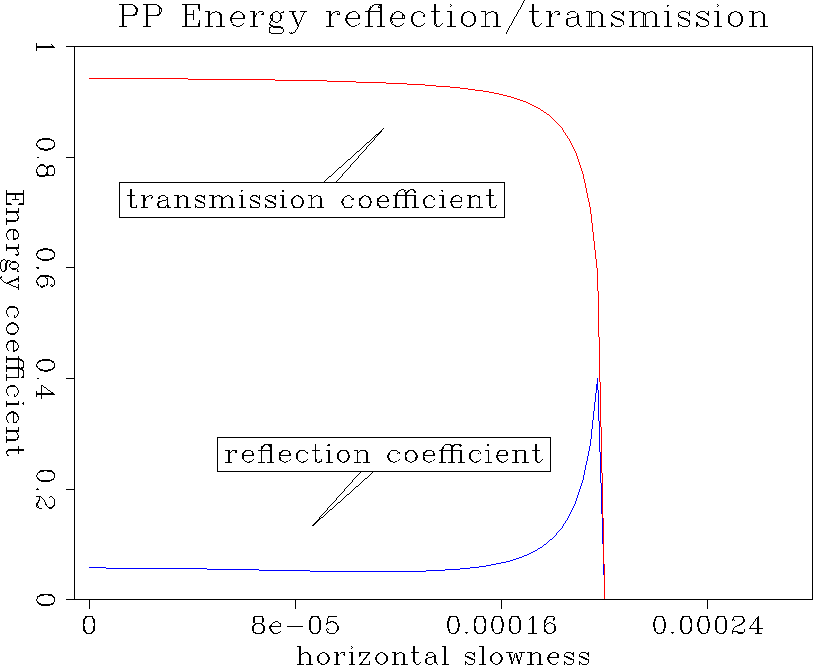 |
 |
Such a test is clearly necessary, if we want to make sure the modeling algorithm produces correct reflection coefficients at medium interfaces. The above test gives us confidence in the modeling algorithm for this type of blocky model.
Using S&M equivalent medium theory, we ``add'' fractures to the chalk-rock matrix. The cracks are vertical and have a constant azimuth along the inline direction. We generally compare inline and crossline amplitude effects produced by the fracturing. Amplitude analysis is carried out in the slant-stack domain.