


![[*]](http://sepwww.stanford.edu/latex2html/cross_ref_motif.gif) ) and () relate TI elastic
constants and NMO velocities, but to perform and interpret
anelliptic moveout we will also need equations relating TI elastic constants
and the anelliptic parameter FW.
For the SH wavetype
) and () relate TI elastic
constants and NMO velocities, but to perform and interpret
anelliptic moveout we will also need equations relating TI elastic constants
and the anelliptic parameter FW.
For the SH wavetype  ,because SH waves in TI media are exactly elliptically anisotropic.
For the qP and qSV wavetypes we have to begin by deriving
a general form.
We proceed by constructing a power series for T(p)
in the same form as equation (). That done,
we can just match coefficients on like powers of p.
,because SH waves in TI media are exactly elliptically anisotropic.
For the qP and qSV wavetypes we have to begin by deriving
a general form.
We proceed by constructing a power series for T(p)
in the same form as equation (). That done,
we can just match coefficients on like powers of p.
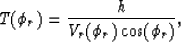
Start with the equation for the traveltime through a layer,
 |
(30) |
 is the traveltime through a layer of thickness
h,
is the traveltime through a layer of thickness
h,  is the group velocity,
and
is the group velocity,
and  is the group propagation direction.
After some algebra to convert from group to phase variables
equation () becomes
is the group propagation direction.
After some algebra to convert from group to phase variables
equation () becomes
 |
(31) |
 is the first derivative of W.
(See equation () for W(S) in the TI case.)
is the first derivative of W.
(See equation () for W(S) in the TI case.)
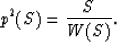
The ray parameter p can also be expressed as a simple function of S and W(S):
 |
(32) |
) to get power series for
p2(S) and T(S), respectively.
Finally, we revert p2(S) and composite the resulting series S(p2) with the series T(S), obtaining
 |
(33) |
 (refer back to equation ())
to emphasize the similarity between
equations () and ().
The term
(refer back to equation ())
to emphasize the similarity between
equations () and ().
The term  is also invariant under changes of vertical scale (as we knew it must be
from the symmetry of the problem).
is also invariant under changes of vertical scale (as we knew it must be
from the symmetry of the problem).
Equating the p4 terms
in equations () and () we obtain
the desired equation for the paraxial value of FW:
 |
(34) |
Although we could substitute equation () into equation ()
directly, the resulting hash of elastic constants is best avoided.
The answer is much simpler in terms of
 ,
, ,and
,and  .Using these variables, for the TI qP mode we obtain
 |
(35) |

| |
(36) |

These equations and equation () allow us to find the layer FW
for a given set of TI elastic constants. (Note these equations are
not weak-anisotropy approximations.)
Unfortunately, given a layer FW (perhaps found by anelliptic three-term
``velocity'' analysis) these equations do not appear to put simple
constraints on the corresponding layer elastic constants.