

![[*]](http://sepwww.stanford.edu/latex2html/prev_gr.gif)


Jon Claerbout and Dave Nichols
jon@sep.stanford.edu
INTRODUCTION
Industry uses many scaled adjoint operators. We'd like to define the best scaling functions. It is not clear how to define the ``best'' scaling but one way is to define it as ``that which causes CG inversion to go the fastest''. The rationale for this choice is that inversion is presumeably the goal, and the scaled adjoint is the first step.
Here I will briefly describe conventional wisdom about scaling and then go on to show how spectral scaling of Kirchoff and other operators can be done using multidimensional prediction-error filters.
CONVENTIONAL SCALING
Iterative methods like conjugate gradients (CG) can sometimes be accelerated
by a change of variables.
Say we are solving
 .We implicitly define new variables
  by a ``trial solution''
 (where
  is any matrix of rank
equal the dimension of
is any matrix of rank
equal the dimension of  )getting
 .After solving this system for
,we merely substitute into
to get the solution to the original problem.
The question is whether this change of variables has saved any effort.
On the surface, things seem worse.
Instead of iterative applications of
.After solving this system for
,we merely substitute into
to get the solution to the original problem.
The question is whether this change of variables has saved any effort.
On the surface, things seem worse.
Instead of iterative applications of
 and
and  we have introduced iterative applications of
 and
and  .This is not a problem if the operator is quicker than .Our big hope is that we have chosen so that the number of iterations decreases.
We have little experience
to guide the choice of to cause the number of iterations to decrease
other than that ``columns of
.This is not a problem if the operator is quicker than .Our big hope is that we have chosen so that the number of iterations decreases.
We have little experience
to guide the choice of to cause the number of iterations to decrease
other than that ``columns of
 should have equal scales'' so could be a diagonal matrix scaling columns of .The preconditioning matrix need not even be square.
The use of a preconditioner does not change the final solution unless
the operator has a null space.
In that case, iterating with leads to a solution with
no component in the null space of .On the other hand, iterating with leads to a solution with
no component in the null space of .We will not pause for a proof since no application comes directly to mind.
Scaling the adjoint
Given the usual linearized regression between
data space and model space,  ,the simplest image of the model space results from
application of the adjoint operator
,the simplest image of the model space results from
application of the adjoint operator  .Unless has no physical units, however,
the physical units of
.Unless has no physical units, however,
the physical units of  do not match those of so we need a scaling factor.
The theoretical solution
do not match those of so we need a scaling factor.
The theoretical solution
 suggests the scaling units should be those of
  .We could probe the operator or its adjoint with white noise or a zero frequency input.
Bill Symes suggests we probe with
the data
.We could probe the operator or its adjoint with white noise or a zero frequency input.
Bill Symes suggests we probe with
the data  because it has the spectrum of interest.
He proposes we make our image with
because it has the spectrum of interest.
He proposes we make our image with
 where we choose the weighting function to be:
 |
(1) |
 can be thought of as a diagonal matrix containing the ratio of two images.
A problem with the choice
adjointwt is that
the denominator might vanish or might even be negative.
The way to stabilize any ratio is to revise it
by changing
can be thought of as a diagonal matrix containing the ratio of two images.
A problem with the choice
adjointwt is that
the denominator might vanish or might even be negative.
The way to stabilize any ratio is to revise it
by changing  to
to
 |
(2) |
 is a parameter to be chosen,
and the angle braces
indicate the possible need for
local smoothing.
is a parameter to be chosen,
and the angle braces
indicate the possible need for
local smoothing.
Since a scaled adjoint is a guess at the solution to the regression,
it is logical to choose
values for and the smoothing parameters
that give fastest convergence of the conjugate-gradient regression.
To go beyond the scaled adjoint we can use  as a preconditioner.
To use as a preconditioner
we define implicitly a new set of variables by the substitution  .Then
.Then  .To find instead of we do CG iteration
with the operator
.To find instead of we do CG iteration
with the operator  instead of with .At the end we convert from back to with .
By adjointwt, has physical units inverse to .Thus the transformation has no units
so the variables have physical units of data space.
Note that after one iteration
 we have Symes scaling.
Sometimes it might be more natural to view
the solution with data units than with proper model units .
we have Symes scaling.
Sometimes it might be more natural to view
the solution with data units than with proper model units .
SPECTRAL PRECONDITIONING
In the regression we often think of the model as white,
meaning that it is defined
up to the Nyquist frequency on the computational mesh,
and we think of the data as red,
meaning that it is sampled significantly more densely than
the Nyquist frequency.
Fitting ,we can probe the operator with random numbers  in model space and
we can probe the operator with random numbers
in model space and
we can probe the operator with random numbers  in data space
getting a red model image
and a red synthetic data space
in data space
getting a red model image
and a red synthetic data space
 |
(3) | |
| (4) |
and turn white into red.
Given  we can define a whitening operator
  in model space and
given
in model space and
given  we can define a whitening operator
  in data space.
Red-space iteration
First we use to implicitly define
a new model space  (which I will later justify calling the ``data-colored'' model)
by the substitution
(which I will later justify calling the ``data-colored'' model)
by the substitution
 .Substituting into gives
  .We could solve this by CG iteration of
  .The first step is the adjoint.
After this step,
the data-colored model estimate
.The first step is the adjoint.
After this step,
the data-colored model estimate
 and model estimate
are
and model estimate
are
 |
(5) |
the data-colored model.
White-space iteration
Next we try the data-space whitener which we obtained by pouring a random-number model into and designing a decon filter on the data out.
The regression
 is red,
so it needs a leveling weighting function to whiten it.
Using for the weighting function gives
is red,
so it needs a leveling weighting function to whiten it.
Using for the weighting function gives
 |
(6) |
 .The first iteration is the adjoint, namely,
 |
(7) |
Residual-whitening iteration
Gauss says the noise
 should be whitened.
The data whitener might do it,
but really we should be using the residual whitener.
Thus, after some number of iterations by any method
we have a residual and we can find a whitener for it,
say
should be whitened.
The data whitener might do it,
but really we should be using the residual whitener.
Thus, after some number of iterations by any method
we have a residual and we can find a whitener for it,
say  .Thus the fitting we should do is
 |
(8) |
As previously, pouring random numbers in data space into
the operator  gives a model space
 from which we can derive a whitener
to implicitly define a new model space by
.Converting the regression from to gives
from which we can derive a whitener
to implicitly define a new model space by
.Converting the regression from to gives
 |
(9) |
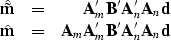 |
(10) |
APPLICATION: DECONVOLVING VELOCITY SPECTRA
Where might spectral scaling be useful?
First I should describe a similar example
with a surprising outcome.
With Kirchoff operators in PVI and BEI
I proposed integrating the velocity transform with
the rho filter  .Dave Nichols tested this idea and found that the rho filter
accelerates the early steps, but retards all the others!
This suggests that deconvolution might suffer the same fate.
On the other hand, the slowed convergence with might simply be a consequence of Fourier methods spreading signals
long distances with wraparounds that would not be part of a decon approach.
In any event, improving the first iteration is a worthwhile goal.
.Dave Nichols tested this idea and found that the rho filter
accelerates the early steps, but retards all the others!
This suggests that deconvolution might suffer the same fate.
On the other hand, the slowed convergence with might simply be a consequence of Fourier methods spreading signals
long distances with wraparounds that would not be part of a decon approach.
In any event, improving the first iteration is a worthwhile goal.
The practical goal
is not just to handle the simple rho-filter effect,
but to cope with truncations and irregular data sampling.
The model space is a regular mesh
(although the data might be on an irregular one)
so deconvolution there always makes sense.
To manufacture a striking example,
I would consider velocity transformation
with a short, wide-offset marine cable, say extending from 1.5 to 2.0 km.
The velocity space would be strongly ``dipped''
so a simple  filter should be able to flatten its dip spectrum.