Next: CONCLUSIONS AND FUTURE WORK
Up: COMMON-AZIMUTH DEPTH MIGRATION TEST
Previous: Data set and preprocessing
The superposition of the migrated results onto the velocity
model (Figure ![[*]](http://sepwww.stanford.edu/latex2html/cross_ref_motif.gif) ) shows that common-azimuth migration
successfully imaged the reflectors and correctly positioned
them in depth.
The migrated salt boundaries overlap quite
precisely with the salt boundaries identified by
the sharp variations in the velocity model.
The target reflectors below the salt layer are also well imaged,
though it seems that their focusing could
be improved by further refinements of the velocity function.
When the same velocity function used
for common-azimuth migration
was used for 3-D prestack Kirchhoff depth migration
small residual moveout corrections
of the migrated CRP gathers were required to maximize
the image energy.
) shows that common-azimuth migration
successfully imaged the reflectors and correctly positioned
them in depth.
The migrated salt boundaries overlap quite
precisely with the salt boundaries identified by
the sharp variations in the velocity model.
The target reflectors below the salt layer are also well imaged,
though it seems that their focusing could
be improved by further refinements of the velocity function.
When the same velocity function used
for common-azimuth migration
was used for 3-D prestack Kirchhoff depth migration
small residual moveout corrections
of the migrated CRP gathers were required to maximize
the image energy.
The accuracy of common-azimuth migration
can be analyzed in more
detail by plotting smaller sections of the data,
and compare the results of full 3-D prestack migration
with multi-line 2-D prestack migration.
The difference between the two results are mostly
visible in the cross-line sections,
where the lack of focusing in the multi-line 2-D migration
results manifests itself.
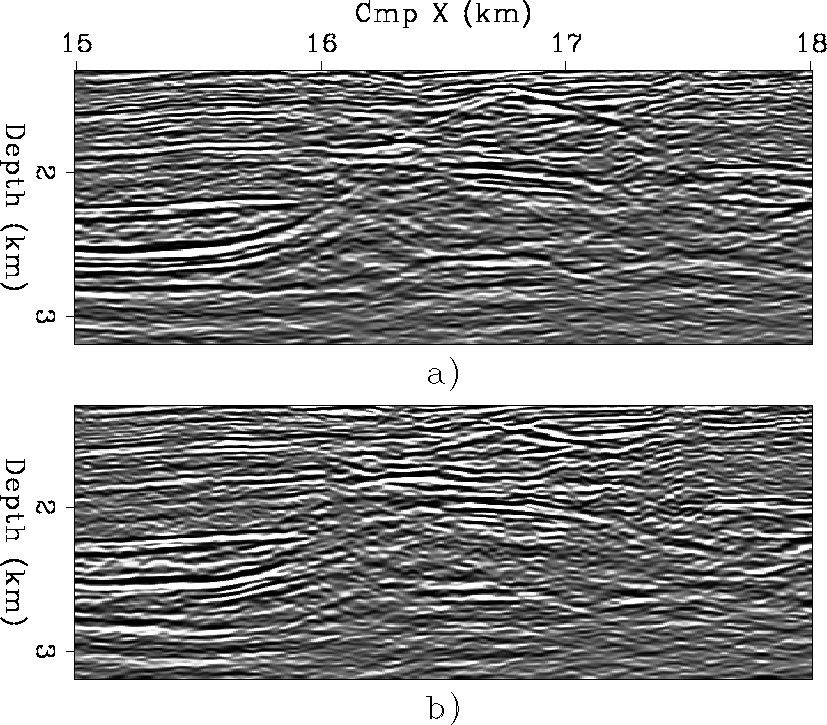
In the following sequence of figures I show three cross-line
sections located at the left-edge, in the middle,
and at the right edge, of the central fault system.
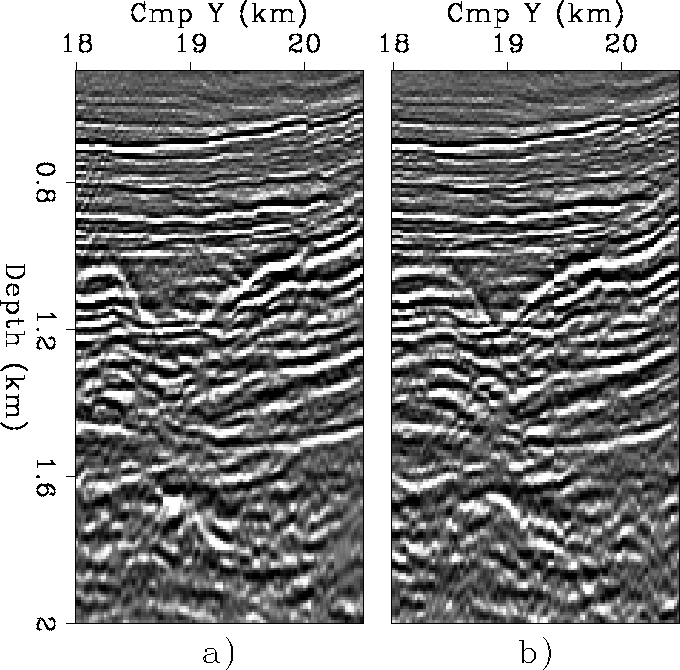
Figure shows the comparison of the common-azimuth
migration (left) and of the multi-line 2-D migration (right)
for the same cross-line.
The most obvious differences between the two sections
are in the reflections from the boundary
between the Jurassic and the Triassic formations,
located at about 1.1 km in depth.
Common-azimuth correctly positioned the lithological
boundary, while multi-line 2-D migration mispositioned
the boundaries by several hundred meters
and did not properly focus the reflector.
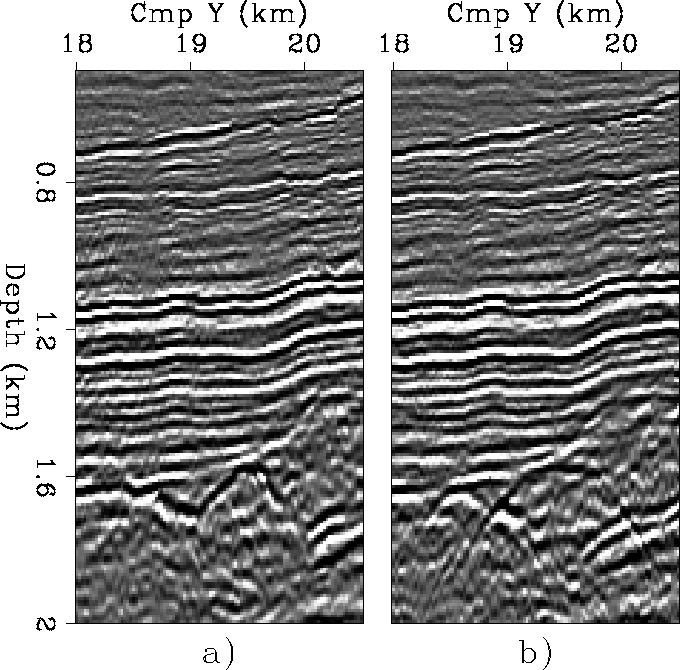
The lack of focusing in the cross-line direction prevents
multi-line 2-D migration from properly imaging the top of the salt layer,
visible in Figure at a depth of about 1.6 km.
Unfocused diffractions are clearly visible in the multi-line 2-D migration
results (right panel in the figure).
On the other hand, common-azimuth migration (left)
nicely images the roughness at the top of the salt.
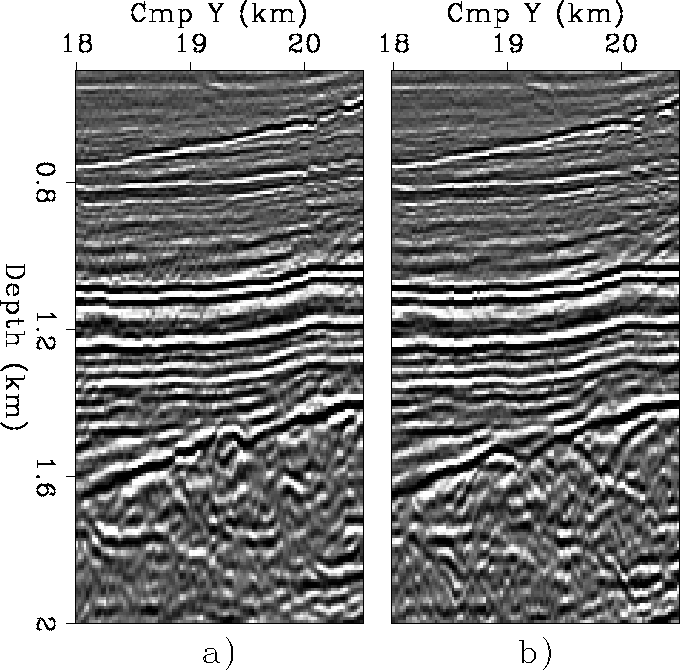
A similar situation is shown in the cross-line
sections of Figure .
Common-azimuth migration correctly
focuses the diffractions caused by
the uneven top of the salt, as well as
the diffractions caused by the shallow faults
visible at the top-right corner of the sections.
x16088
Figure 3 Migrated cross-line sections (CMP X=16.088 km)
obtained by a) 3-D common-azimuth migration, b) multi-line 2-D migration.


 x16566
Figure 4 Migrated cross-line sections (CMP X=16.566 km)
obtained by a) 3-D common-azimuth migration, b) multi-line 2-D migration.
x16820
Figure 5 Migrated cross-line sections (CMP X=16.82 km)
obtained by a) 3-D common-azimuth migration, b) multi-line 2-D migration.
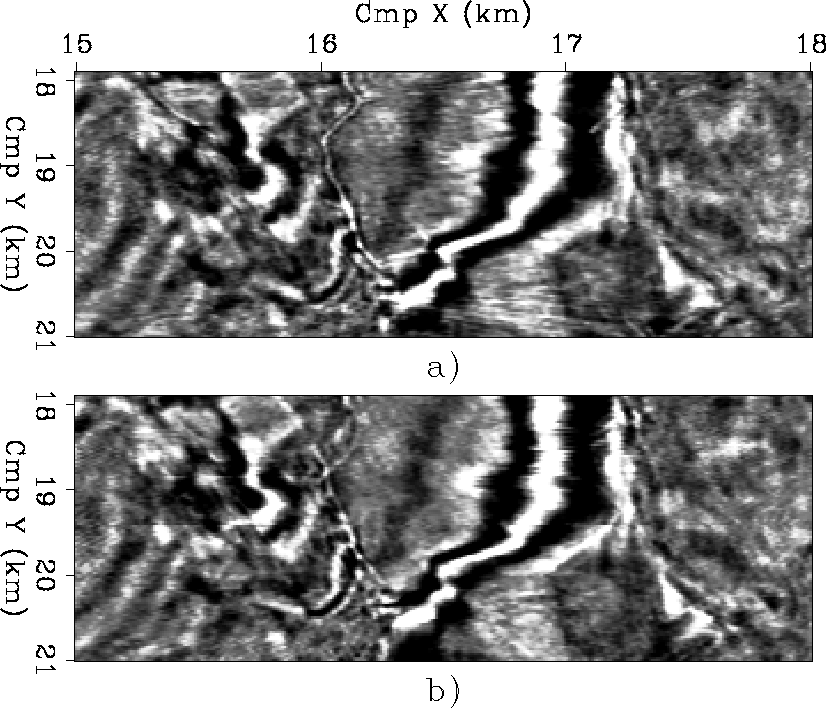
The lack of cross-line focusing in the multi-line 2-D migration
is also evident in the depth slices shown in
Figure .
These depth slices, taken at a depth of 1.096 km,
clearly show the reflections from the boundary between
the Jurassic and the Triassic formations around
the in-line midpoint location of 16 km.
This is the same event previously shown
in the cross-line sections of Figure .
Examining this depth slice we can verify that
common-azimuth migration correctly positions
the reflection at the true boundary between the formations,
while multi-line 2-D migrations mispositions the boundary,
even transforming it in a bowtie-shaped event around
the cross-line midpoint location of 19 km.
The set of faults cutting across the broad reflection
located between 16.5 km and 17 km in the in-line direction is also more
sharply imaged by common-azimuth migration
than by multi-line 2-D migration.
z1096
Figure 6 Migrated depth slices (Z=1.096 km)
obtained by a) 3-D common-azimuth migration, b) multi-line 2-D migration.
Figure compares
the results of common-azimuth migration (top)
and multi-line 2-D migration (bottom)
when imaging the salt layer and the target reflectors below it.
The salt boundaries are fairly well imaged by common-azimuth migration,
including the bottom of the salt and part of the salt flanks.
I expect that a dip-preserving transformation
to common-azimuth that includes AMO in the processing sequence
would improve the imaging of the steeply dipping
salt flanks.
The reflectors below the reservoir are well imaged,
although with uneven amplitudes.
Refinements in the velocity model may improve the
imaging of these reflectors.
On the contrary, the multi-line 2-D migration poorly images
the bottom of the salt layer and the reflector below the salt.
The salt flanks are almost totally lost in the multi-line 2-D migration
image as well.
Two effects play a role to cause the large differences
between the two migrations when imaging reflectors that
have a fairly mild cross-line dip component.
First, the large width of the cross-line migration
aperture at this depth makes the images very sensitive to cross-line dips.
Second, common-azimuth migration correctly takes into account
the cross-line velocity variations because it
correctly propagates the wavefield in the cross-line direction
as well in the in-line direction.
On the contrary, multi-line 2-D migration constrains the wavefield
to propagate along the vertical in-line planes,
and cannot fully honor the 3-D nature of the velocity function.
y20000
Figure 7 In-line sections (CMP Y=20 km)
obtained by a) 3-D common-azimuth migration, b) multi-line 2-D migration.
Next: CONCLUSIONS AND FUTURE WORK
Up: COMMON-AZIMUTH DEPTH MIGRATION TEST
Previous: Data set and preprocessing
Stanford Exploration Project
11/11/1997