Next: Conclusions
Up: Testing for Kirchhoff migration
Previous: Velocity function
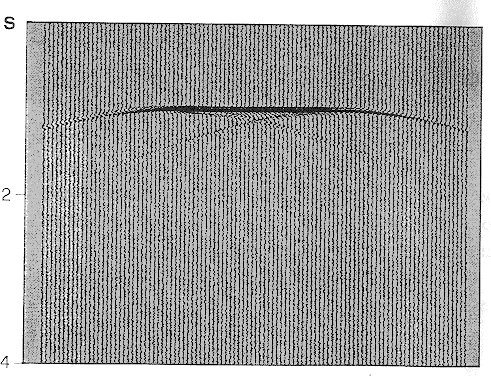
Random noise was added to the zero-offset section of the horizontal
reflector in Figure 2, where the medium was assumed to have a constant
velocity equal to 2000 m/s. The noisy section is shown in Figure 15.
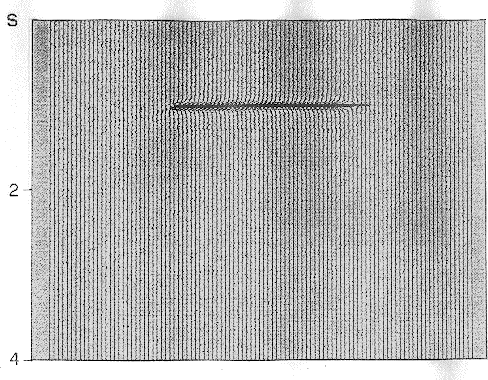
The corresponding migrated section in Figure 16 shows that the noise
in the section has decreased in amplitude as a result of migration.
Note that a constant scaling factor
was applied to the section so that the noise
could actually be seen, hence the very large amplitudes of the
reflector. It can be seen from the figure that noise amplitudes
become lower down the section. This time-variant reduction of noise
is due to the time factor in the spherical spreading term of Kirchhoff
summation, as was explained earlier on.
f3-26a
Figure 15
Zero-offset seismic response of a horizontal reflector (shown in
Figure 2) with random noise added to the section.

f3-26b
Figure 16
Migration (constant velocity medium).
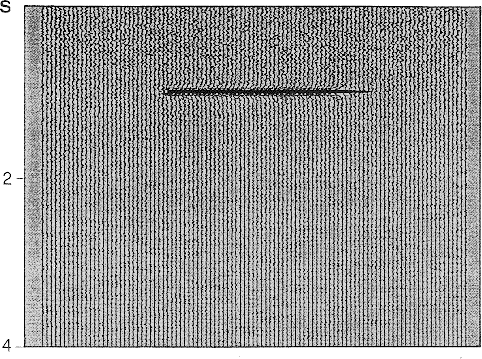
The zero-offset seismic response of the same reflector was generated
using a time-variant velocity function, where velocity increases with
increasing traveltime. Its output migrated section is shown in Figure
17. Here the variable velocity factor results in a greater reduction
of noise towards the bottom of the section, where the velocities are
higher. However the background noise looks more coherent as its
amplitude is decreased, that is, in the deeper parts of the section.
f3-26c
Figure 17
Migration (medium velocity increases with increasing time).
Next: Conclusions
Up: Testing for Kirchhoff migration
Previous: Velocity function
Stanford Exploration Project
11/11/1997