


Next: OPPORTUNITIES FOR SMART DIRECTIONS
Up: PRECONDITIONING THE REGULARIZATION
Previous: Statistical interpretation
Summing up the ideas above,
we start from fitting goals
| 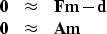 |
(8) |
and we change variables from
 to
to  using
using

|  |
(9) |
Preconditioning means iteratively fitting
by adjusting the variables
and then finding the model by using
.
A new reusable
preconditioned solver is
the module prec_solver ![[*]](http://sepwww.stanford.edu/latex2html/cross_ref_motif.gif) .
The variable x
in prec_solver refers to .Likewise the modeling operator
.
The variable x
in prec_solver refers to .Likewise the modeling operator  is called oper
and the smoothing operator
is called oper
and the smoothing operator  is called prec.
Details of the code are only slightly different from
the regularized solver
reg_solver .
is called prec.
Details of the code are only slightly different from
the regularized solver
reg_solver .
Next: OPPORTUNITIES FOR SMART DIRECTIONS
Up: PRECONDITIONING THE REGULARIZATION
Previous: Statistical interpretation
Stanford Exploration Project
12/15/2000