![[pdf]](icons/pdf.png)
|
|
|
|
| Gradient of image-space wave-equation tomography by the adjoint-state method | |
|
 , that minimizes the nonlinear objective function:
 is the image perturbation that measures the accuracy of the slowness model. To compute
 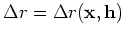 , a differential residual-focusing operator
  is applied to the image
 obtained with the current slowness (Biondi, 2008), using either differential residual prestack migration (Sava and Biondi, 2004a,b) or differential-semblance optimization (DSO) operators (Shen and Symes, 2008). In this paper, operators are represented by bold capital letters.
If the differential residual-focusing operator is independent of the slowness, the gradient of this objective function evaluated at the current slowness
 is
is
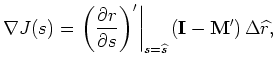 is the identity operator, and
 is the perturbed image obtained with the current slowness model. The linear operator
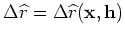 defines the mapping
 between the slowness perturbation
  and the image perturbation ; it is called the image-space wave-equation tomographic operator.
Because the image-space wave-equation tomographic operator is composed of different operators, it is difficult to envision from equation 8 which operations are performed to compute the gradient. Therefore, for a clear explanation of the operators involved, I use the adjoint-state method to derive the gradient of the objective function (equation 7).
In migration with generalized sources or shot-profile migration, the source and receiver wavefields are propagated independently, and the image
 at a depth level
 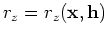 , is computed by the crosscorrelation
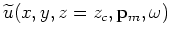
 is the source wavefield for a single frequency
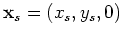
  at horizontal coordinates
 ;
;
 is the receiver wavefield,
 is the subsurface half-offset, and ``
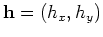 '' stands for the complex-conjugate. An additional summation over shots is required when migrating more than one shot. Hereafter, letters
  and
and  stand for source and receiver wavefields, respectively, irrespective of the migration scheme.
In a more compact notation, not explicitly writing the dependencies on  and
and  , equation 9 can be re-written as follows:
 and
and  are convolutional operators composed of
  -shifted versions of
and
, respectively. Operator
-shifted versions of
and
, respectively. Operator  corresponds to the summation over frequency.
For subsequent depth levels,
 is computed by means of the recursive downward propagation
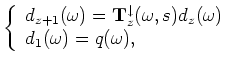 is the downward continuation operator, which is a function of the slowness
  , and
, and  is the source wavefield used as a boundary condition. In the case of conventional shot-profile migration,
 is the source signature located at
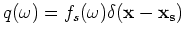 . If using the generalized sources in the image space, represents the image-space phase-encoded source wavefield of equation 3.
The downward continuation of the receiver wavefield is performed by
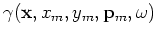
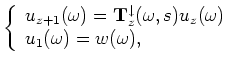 is the recorded data at the surface for shot-profile migration. If using generalized sources in the image space, is the phase-encoded areal receiver wavefield of equation 4. In equations 11 and 12, I omitted the dependencies of the wavefield with respect to
  . The subscript
  in equations 11 and 12 represents the surface for the shot-profile migration and the ``collection'' depth level,
  , for the image-space phase-encoded wavefields.
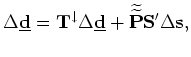
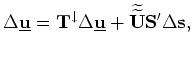
In the image-space wave-equation tomography problem, the perturbed source and receiver wavefields, and the image perturbation are used to compute the slowness perturbation that updates the current slowness model. From the perturbation theory, we have
 ,
,
 , and, consequently,
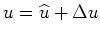 are physical realizations with
 , where the
  refers to fields obtained with the background slowness. To the first order (Born approximation), these perturbed fields are given by
 and
and
 have in the diagonal entries the scattered source and receiver wavefields, respectively. These wavefields are given by the action of the scattering operator
 on the background wavefields:
The perturbed image is given by
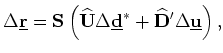 is a spreading operator that replicates the slowness perturbation for every frequency.
Equations 18, 19, and 20 are the forward modeling equations of the image-space wave-equation tomography problem using the generalized sources or shot-profile schemes. They depend on the state variables
 ,
,
 , and
, and
 . Plessix (2006) describes how to compute the adjoint states using the augmented functional methodology. By introducing the adjoint-state variables
 ,
,
 , and
, and
 , the augmented Lagrangian reads
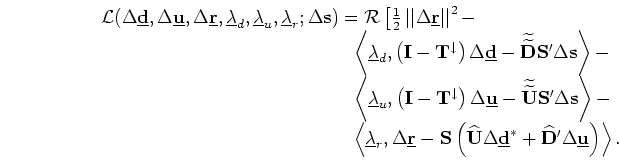 with respect to the state variables and equating to zero, which gives
 |
(22) |
Finally, the gradient of  is
is
and
, are upward propagated and cross-correlated in time with the scattered wavefields.
|
|
|
|
| Gradient of image-space wave-equation tomography by the adjoint-state method | |
|