


 array
and pack the array into a vector of components.
Likewise pack the Laplacian operator
array
and pack the array into a vector of components.
Likewise pack the Laplacian operator  into a matrix.
For a
into a matrix.
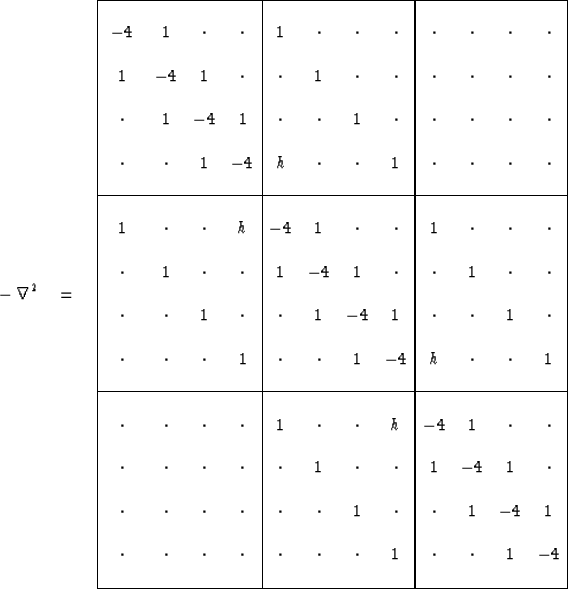
For a  plane, that matrix is shown in equation (7).
 |
(7) |
The two-dimensional matrix of coefficients for the Laplacian operator
is shown in (7),
where,
on a cartesian space, h=0,
and in the helix geometry, h=1.
(A similar partitioned matrix arises from packing
a cylindrical surface into a  array.)
Notice that the partitioning becomes transparent for the helix, h=1.
array.)
Notice that the partitioning becomes transparent for the helix, h=1.
With the partitioning thus invisible, the matrix simply represents one-dimensional convolution and we have an alternative analytical approach, one-dimensional Fourier Transform. We often need to solve sets of simultaneous equations with a matrix similar to (7). A costly method is to factor the matrix into upper and lower triangular form that can be ``backsolved'' which in this case amounts to recursive filtering.
The Fourier approach of the next section
is roughly equivalent to
factoring  into upper and lower triangular matrices,
but it is much faster owing to the convolutional nature of the matrix.
The (negative of the) Laplacian operator is regarded as an
autocorrelation
into upper and lower triangular matrices,
but it is much faster owing to the convolutional nature of the matrix.
The (negative of the) Laplacian operator is regarded as an
autocorrelation
 |
(8) |
 |
(9) |
![\begin{displaymath}
\bold r \eq
\left[
\begin{array}
{rrr}
& -1 & \\ -1 & 4 & -1 \\ & -1 &
\end{array}\right]\end{displaymath}](img17.gif) |
(10) |
![\begin{displaymath}
\bold a \eq
\left[
\begin{array}
{rrrrrrrrr}
& & & & 1.79...
...ts &-.044 & -.087 & -.200 & -.558 & & & &
\end{array} \right]\end{displaymath}](img18.gif) |
(11) |
 |
(12) |
 is constructed from the
row (9)
as follows:
Each row of the matrix
is constructed from the
row (9)
as follows:
Each row of the matrix  contains the row (9)
shifted along itself so that the 1.791 lies along the main diagonal
of the matrix.
contains the row (9)
shifted along itself so that the 1.791 lies along the main diagonal
of the matrix.
Unfortunately, we see that the factored operator has a great number of nonzero terms,
but fortunately they seem to be converging rapidly
so truncation seems reasonable.
We can use this feedback operator to solve Poisson's equation very rapidly.
Polynomial division and its adjoint gives us
 which means that we have solved the PDE
 by using polynomial division on a helix.
Using the seven coefficients shown,
the cost is fourteen multiplications
(because we need to run both ways) per mesh point.
An example is shown in Figure 7.
by using polynomial division on a helix.
Using the seven coefficients shown,
the cost is fourteen multiplications
(because we need to run both ways) per mesh point.
An example is shown in Figure 7.
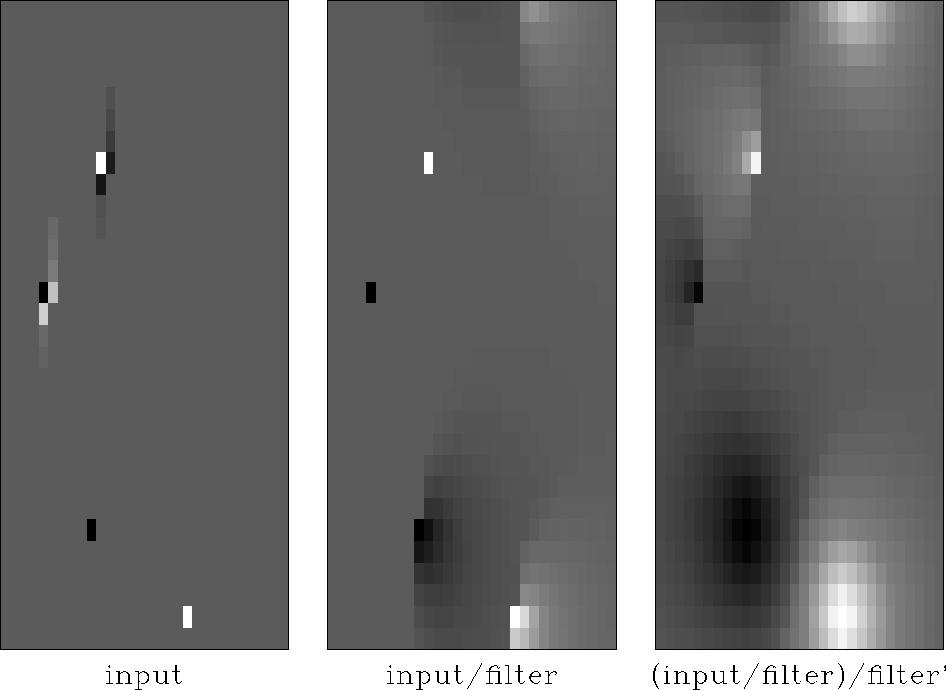 |
 ; Middle is
  ; Right is
  .
.


We are all aware of the factorization of  into a divergence dotted into a gradient,
where the divergence is the adjoint of the gradient.
In two-dimensional physical space,
the gradient maps one field to two fields.
The factorization of with the helix
gives us an operator that maps one field to one field.
into a divergence dotted into a gradient,
where the divergence is the adjoint of the gradient.
In two-dimensional physical space,
the gradient maps one field to two fields.
The factorization of with the helix
gives us an operator that maps one field to one field.
Any fact this basic should be well known in some arcane field
of mathematics or theoretical physics.
Meanwhile, being ignorant of any pre-existant name,
I have chosen the name ``helix derivative''
or ``helical derivative'' for the operator .(Admittedly, the concept exists on an infinite cartesian plane
without a helix, but all my codes in a finite space involve the helix,
and the helix concept led me to it.)
Our construction makes have the energy spectrum kx2+ky2,
so the magnitude of the Fourier transform is  .This rotationally invariant function in the Fourier domain
contrasts sharply with the nonrotationally invariant
function shape in (x,y)-space.
The difference must arise from the phase spectrum.
The factorization (11)
is nonunique in that causality
associated with the helix mapping
can be defined along either x or y axes;
thus the operator
(11)
can be rotated or reflected.
.This rotationally invariant function in the Fourier domain
contrasts sharply with the nonrotationally invariant
function shape in (x,y)-space.
The difference must arise from the phase spectrum.
The factorization (11)
is nonunique in that causality
associated with the helix mapping
can be defined along either x or y axes;
thus the operator
(11)
can be rotated or reflected.