


![[*]](http://sepwww.stanford.edu/latex2html/cross_ref_motif.gif) and
invstack() .
and
invstack() .
module unwrap {
	use cgstep_mod
	use igrad2
	use simple_solver
contains
	subroutine grad2init( z,n1,n2, rt ) {
	integer  i, j,          n1,n2
	real                           rt( n1,n2,2)
	complex               z(n1,n2),             a,b,c
	rt = 0.
	do i= 1, n1-1 {
	do j= 1, n2-1 {
        	a =  z(i  ,j  )
        	c =  z(i+1,j  );     rt(i,j,1) =  aimag( clog( c * conjg( a) ) )
        	b =  z(i,  j+1);     rt(i,j,2) =  aimag( clog( b * conjg( a) ) )
        	}}
	}
	# Phase unwraper.   Starting from phase h, improve it.
	subroutine unwraper( zz, hh, niter) {
	integer  n1,n2,              niter
	complex            zz(:,:)
	real               hh(:)
	real, allocatable ::  rt(:)
	n1 = size (zz, 1)
	n2 = size (zz, 2)
	allocate( rt (n1*n2*2))
	call grad2init( zz,n1,n2,rt)
	call igrad2_init(  n1,n2)
	call solver( igrad2_lop, cgstep, hh, rt, niter, x0 = hh)
	call cgstep_close ()
	deallocate( rt)
	}
}
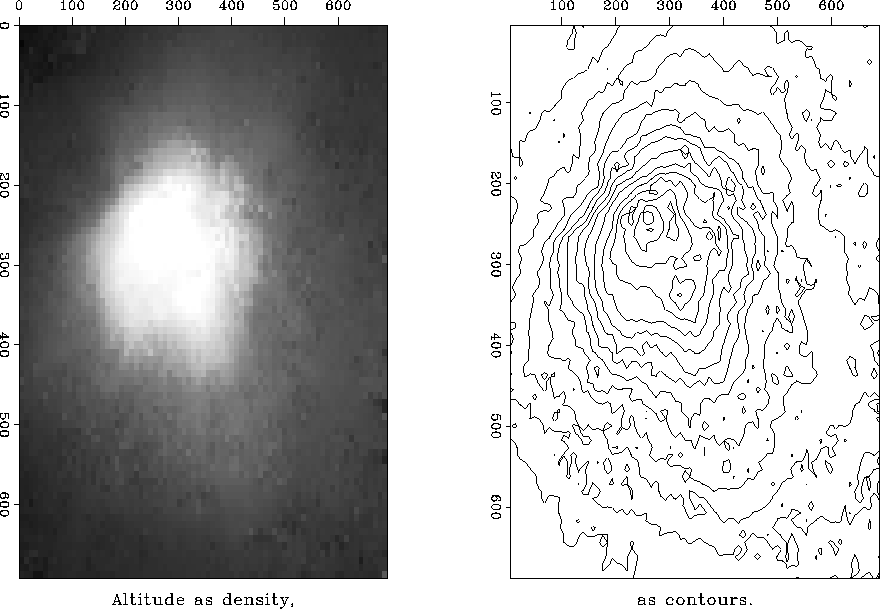
An open question is whether the required number of iterations is reasonable or whether we would need to uncover a preconditioner or more rapid solution method. I adjusted the frame size (by the amount of smoothing in Figure 3) so that I would get the solution in about ten seconds with 400 iterations. Results are shown in Figure 5.
 |


