


 , two cases need
to be distinguished.
, two cases need
to be distinguished.
The under-determined case: The least-squares inverse of m for each frequency is
 |
(14) |
 is the estimate of the model,
 a matrix
  to invert,
and
to invert,
and  .
.
The over-determined case: The least-squares inverse for m for each frequency is
 |
(15) |
 is a
is a  matrix to
invert with a Toeplitz structure Darche (1990); Kostov (1989).
matrix to
invert with a Toeplitz structure Darche (1990); Kostov (1989).
An interesting problem occurs when the conditioning
of the matrix quickly deteriorates as frequencies increase. This effect
is partly caused by the frequency truncation of the operator. A
solution to this problem is to increase  , which appears
in equations (14) and (15), with the frequency. To do so, I set
, which appears
in equations (14) and (15), with the frequency. To do so, I set
 |
(16) |
 a constant
to set apriori. This choice of
a constant
to set apriori. This choice of  allows us to increase
the regularization with the frequency but not too much.
Indeed a too strong regularization would affect the amplitude recovery
of the data.
allows us to increase
the regularization with the frequency but not too much.
Indeed a too strong regularization would affect the amplitude recovery
of the data.
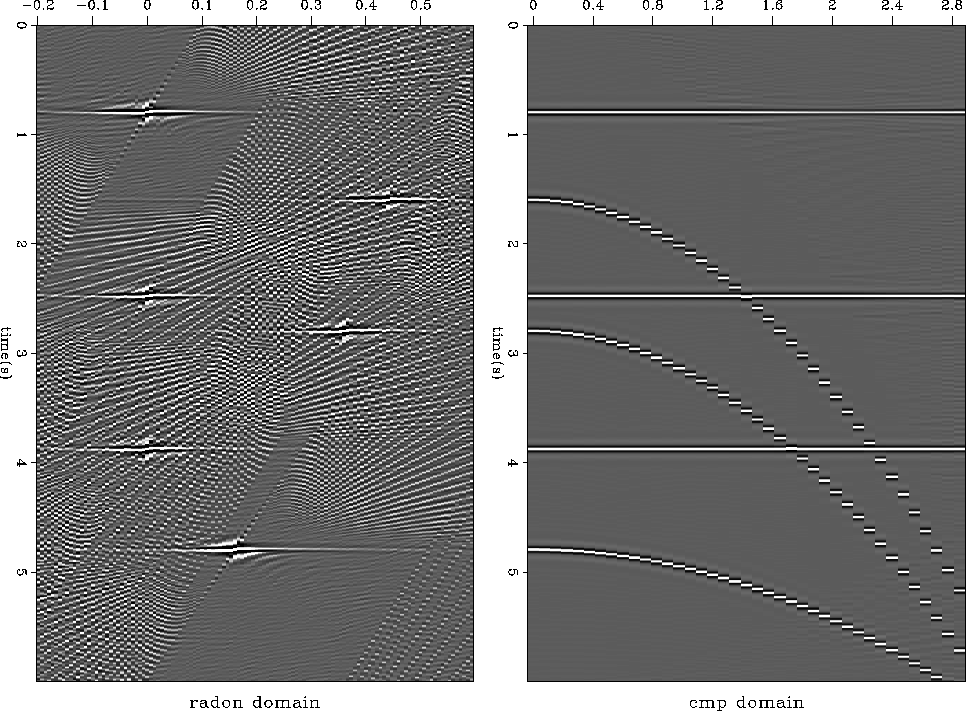
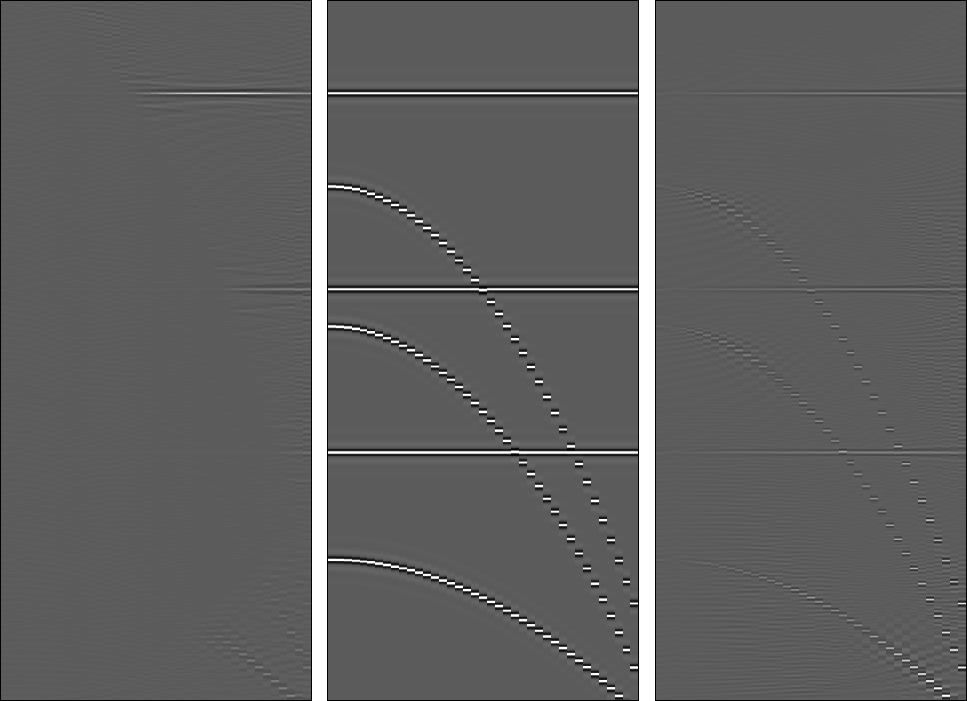
The size of the matrix to invert makes possible the use of direct inversion as opposed to iterative processes. Figure 5 shows the result of inversion using the aliased operator. The aliasing artifacts are still strong, but some energy has focused, decreasing the width of the horizontal events caused by near-offset aperture effects. The resulting data, which appear in the right panel of Figure 5, are almost perfectly recovered. The residual in the left panel of Figure 7 demonstrates that the data fitting is nearly perfect.
 |


Now, using the antialiasing conditions on the operator, we obtain the data in Figure 6: events are better focused in the radon domain and most of data aliasing artifacts have disappeared. We observe a loss of resolution for the non-flat events caused by the antialiasing conditions. The aliasing of the input data produces the remaining noisy events in the radon domain. Again, the data in the right panel of Figure 6 are almost completely recovered, and the residual in the right panel of Figure 7 is very small.
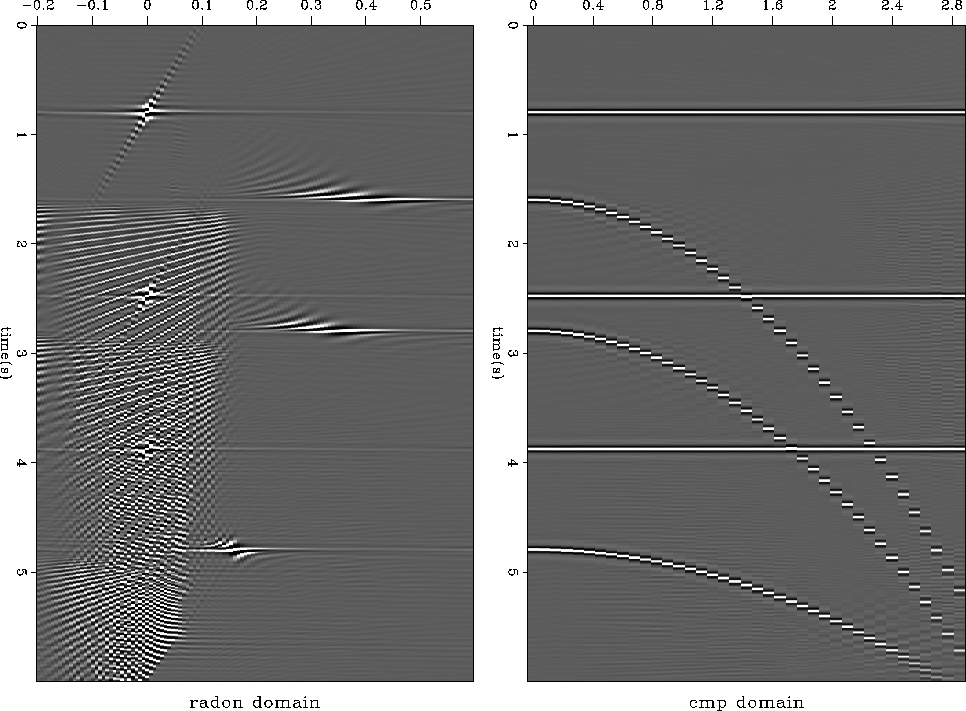 |
This result proves that the antialiasing PRT can be inverted as long as
is provided. It also proves that the use
of antialiasing conditions on the operator helps to mitigate data
aliasing artifacts. However, as Figure 6 indicates, data aliasing
effects can't be totally removed.
The next section shows that sparseness conditions in the radon
domain can destroy data aliasing artifacts.
 |