


|
pflip
Figure 1 Polarity inversion in converted waves seismic data. +g and -g correspond to positive and negative polarity in a common shot gather. Modified from Tatham and McCormack (1991). | 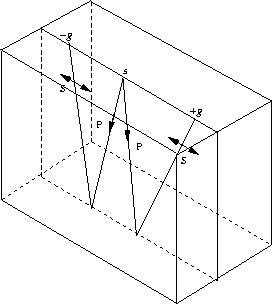 |

For media with more complex velocity, the normal incidence ray
determines the location of the polarity flip.
For flat reflectors in v(z) media, and in areas with constant
 , the normal incidence ray emerges at
the surface at zero-offset.
However, in general, the P and S-wave ray paths corresponding to
the normal-incidence (zero-amplitude) ray will not necessarily emerge
at the surface at the same point.
Figure 2 illustrates this for the case of a dipping
layer and a non-constant .
, the normal incidence ray emerges at
the surface at zero-offset.
However, in general, the P and S-wave ray paths corresponding to
the normal-incidence (zero-amplitude) ray will not necessarily emerge
at the surface at the same point.
Figure 2 illustrates this for the case of a dipping
layer and a non-constant .
This path deviation produces a polarity reversal at non-zero offset in the data space. In areas of complex structure, the picking of this polarity flip point is difficult; however, in the angle domain (model space), this point is a uniquely determined function of the P-velocity, S-velocity, and reflector dip; therefore, it is easy to correct the polarity flip in the model space.
|
pflip2
Figure 2 Polarity flip problem for a dipping layer and a non-constant . | 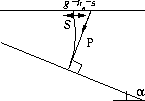 |