


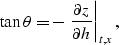
Fomel (1996) presented the following partial differential equation describing an image surface in depth-midpoint-offset space:
 |
(1) |
 is the P-wave opening or incidence angle.
For converted waves, has a no simple physical interpretation.
In this case, is a complex function of the
P-incidence angle, the S-reflection angle, and the structural
dip,  (Figure 3).
Figure 3 shows the geometrical relationship between the
P-incidence angle, the S-reflection angle, and the structural
dip with the opening angle for the converted waves case.
Following Fomel's 1996 derivation we will
derive the PS relationship for
angle domain common image gathers.
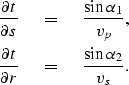
In order to relate the first-order traveltime derivatives of
the PS-wave with the P-incidence angle and the S-reflection angle,
we use the well-known equations for apparent slowness
(Figure 3).
Figure 3 shows the geometrical relationship between the
P-incidence angle, the S-reflection angle, and the structural
dip with the opening angle for the converted waves case.
Following Fomel's 1996 derivation we will
derive the PS relationship for
angle domain common image gathers.
In order to relate the first-order traveltime derivatives of
the PS-wave with the P-incidence angle and the S-reflection angle,
we use the well-known equations for apparent slowness
 |
(2) | |
| (3) |
|
sergey
Figure 3 Reflection rays for a PS-data in a constant velocity medium (Adapted from Fomel 1996). |  |

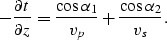
Considering the traveltime derivative with respect to the depth of the observation surface (z), the contributions of the two branches of the reflected ray add together to form
 |
(4) |
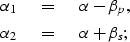
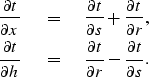
Introducing midpoint  and half-offset
  coordinates,
and relating
coordinates,
and relating  and
and  with the P-incidence angle (
 ),
the S-reflection angle (
),
the S-reflection angle ( ), and the structural dip ()
 |
||
 |
||
We can transform relations (2), (3), and (4) to:
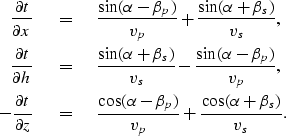 |
(5) | |
| (6) | ||
| (7) |
Dividing (6) by (7) and using elementary trigonometric equalities, we obtain:
 |
(8) |
For vp = vs, the P-incidence angle will be the same as the
S-reflection angle; hence, in equation (8) corresponds
to the ray incidence angle. However,
for converted waves ( ) no such simple physical interpretation
exists, and relates
the P-incidence angle, the S-reflection angle, and
the structural dip.
) no such simple physical interpretation
exists, and relates
the P-incidence angle, the S-reflection angle, and
the structural dip.
For the determination of the polarity flip in the angle domain we
define  as the polarity flip angle, for which the
P-incidence angle equals the S-reflection angle and they are
both equal to zero (
as the polarity flip angle, for which the
P-incidence angle equals the S-reflection angle and they are
both equal to zero ( ), i.e normal incidence.
Thus corresponds to the point of polarity flip in
angle domain.
Equation (8) reduces to:
), i.e normal incidence.
Thus corresponds to the point of polarity flip in
angle domain.
Equation (8) reduces to:
 |
(9) |
It is important to emphasize that for constant  the polarity flip will not necessarily occur at
  because of
the reflector dip effect.
because of
the reflector dip effect.