Next: Conclusions
Up: Interpretation
Previous: Interpretation
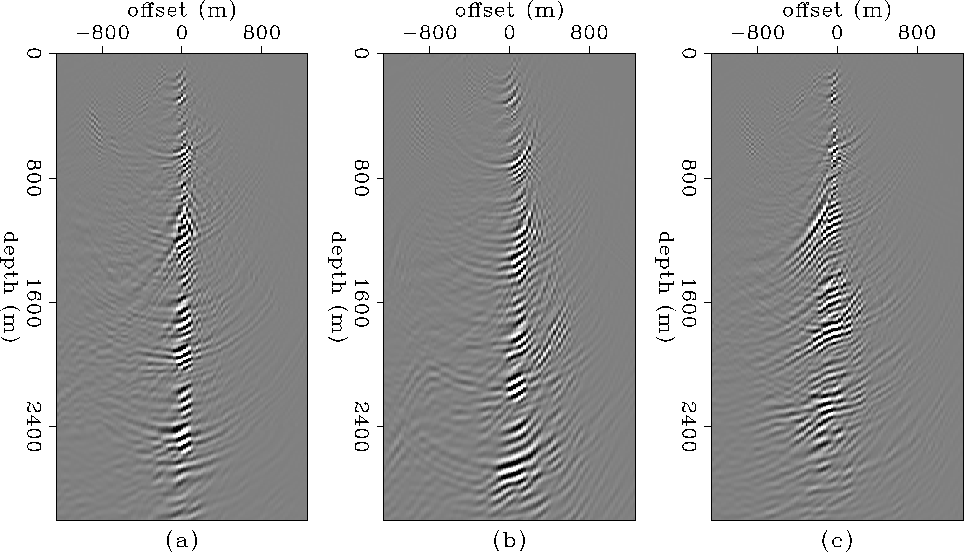
Figure 3 illustrates the effect velocity plays on
offset-domain common-image gathers. The three panels show CIGs
produced by migrating the Marmousi synthetic dataset with three
different velocity models: the correct velocity [panel (a)], a
velocity that is too low [panel (b)], and a velocity model that is too
high [panel (c)].
Interpreting patterns in the offset-domain CIGs is difficult; however,
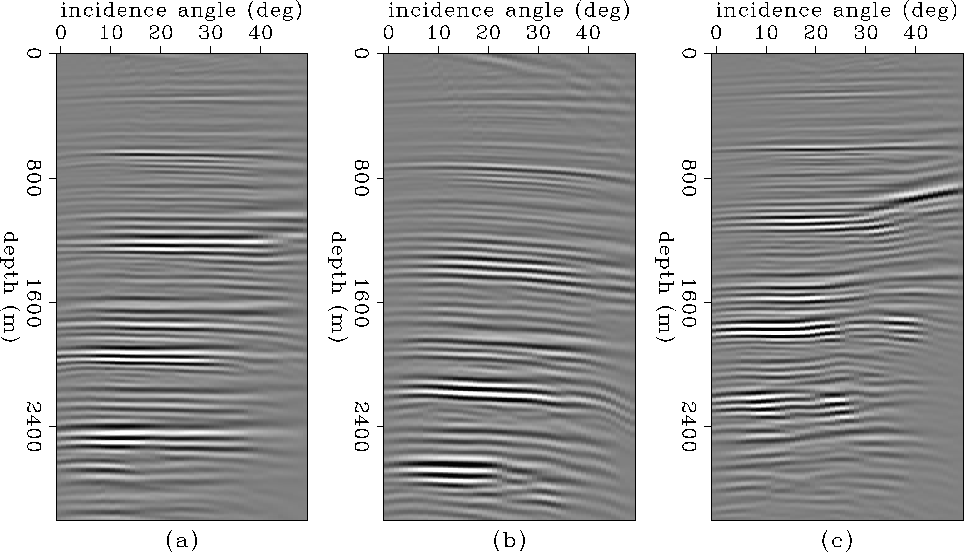
after transformation to the angle domain (Figure 4,
standard residual-moveout patterns indicates the sign of the velocity
error: events curving up meaning too low, and events curving down
meaning too high.
To illustrate the problems associated with sampling for shot-profile
migrations, Figure 5 shows the same image
gathers as Figure 3, but after migrating only
every twentieth shot.
Even if the velocity is correct, energy does not cancel at non-zero
offsets, and so events are not flat in the angle-domain
(Figure 6). When the velocities are incorrect,
the angle gathers remain chaotic: shot aliasing has effectively
rendered the angle-gathers uninterpretable in terms of velocities.
Although both de Bruin's 1991 original methodology
and the approach described here provide means of obtaining
common-image gathers from shot-profile migration, the problem of
shot-aliasing remains important for the geometries that are best
suited to shot-profile migration.
offvel4000
Figure 3 Offset-domain
common-image gathers. Panels (a), (b), and
(c) were migrated with velocity models that were correct, 6% too low,
and 6% too high, respectively.
![[*]](http://sepwww.stanford.edu/latex2html/movie.gif)


 angvel4000
Figure 4 Angle-domain
common-image gathers. Panels (a), (b)
and (c) were migrated with velocity models that were correct, too low,
and too high, respectively.
Next: Conclusions
Up: Interpretation
Previous: Interpretation
Stanford Exploration Project
4/29/2001