


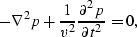
 |
(17) |
 solutions of the form:
 |
(18) |
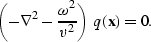 |
(19) |
We can solve the Helmholtz equation on a regular grid by approximating
the differential operator with a finite-difference stencil.
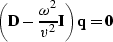
A simple (all-zero) convolutional approximation to the Laplacian,
 , produces the matrix equation:
 |
(20) |
Unfortunately the direct solution of
equation (![[*]](http://sepwww.stanford.edu/latex2html/cross_ref_motif.gif) ) requires
the inversion of a multi-dimensional convolutional matrix.
As with Poisson's equation above, the application of helical boundary
conditions allows me to factor the convolutional filter into a
minimum-phase causal and anti-causal pair that can be inverted rapidly
by polynomial division.
) requires
the inversion of a multi-dimensional convolutional matrix.
As with Poisson's equation above, the application of helical boundary
conditions allows me to factor the convolutional filter into a
minimum-phase causal and anti-causal pair that can be inverted rapidly
by polynomial division.
Factoring the Helmholtz operator
is not as simple as factoring the Poisson operator, since its spectrum
is not positive definite.
The spectrum of the differential Helmholtz operator can be obtained by
taking the spatial Fourier transform of
equation (), to give
 |
(21) |
 represents the spatial Fourier transform of
 , and
, and  is the Fourier
representation of the Helmholtz operator.
is the Fourier
representation of the Helmholtz operator.
 clearly becomes negative real for small
values of
clearly becomes negative real for small
values of  ; so as it stands, the Helmholtz operator does
not represent an autocorrelation, and is not factorable. This problem
also exists for discrete operators [e.g.
equation ()].
; so as it stands, the Helmholtz operator does
not represent an autocorrelation, and is not factorable. This problem
also exists for discrete operators [e.g.
equation ()].
Fortunately replacing  by
by  , where
  is a small positive number,
successfully stabilizes the spectrum, by pushing the function off the
negative-real axis.
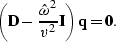
Equation (), therefore becomes
is a small positive number,
successfully stabilizes the spectrum, by pushing the function off the
negative-real axis.
Equation (), therefore becomes
 |
(22) |
is to provide
damping as the wave propagates, differentiating between the forward
and backward extrapolation directions.
With the complex  , the Helmholtz operator is symmetric but
not Hermitian, and so represents a crosscorrelation rather than an
autocorrelation.
, the Helmholtz operator is symmetric but
not Hermitian, and so represents a crosscorrelation rather than an
autocorrelation.
Generalizing the concept of spectral factorization to cross-spectral factorization, Claerbout (1998c) showed that any function whose Fourier transform does not wrap around the origin in the complex plane can be factored into the crosscorrelation of two minimum-phase factors. Since for this class of function, the phase of the Fourier component at the positive Nyquist equals the phase at the negative Nyquist (with no bulk phase shift), he termed this class of function `level-phase'. Although the Helmholtz operator is not strictly an autocorrelation, it does satisfy the `level-phase' criterion, and so it can still be factored into a pair of minimum-phase factors.
Rather than considering a simple convolutional approximation to the Laplacian, we can form a rational approximation,
 |
(23) |
 is Claerbout's 1985 adjustable
`one-sixth' parameter, and
is Claerbout's 1985 adjustable
`one-sixth' parameter, and
 again represents convolution with a simple finite-difference
filter, d.
It is safe to write equation () in this rational form
since the numerator and denominator commute with each other.
again represents convolution with a simple finite-difference
filter, d.
It is safe to write equation () in this rational form
since the numerator and denominator commute with each other.
Inserting equation () into
equation () yields a matrix equation of
similar form, but with increased accuracy at high spatial wavenumbers:
![\begin{eqnarray}
\left( \frac{\bf D}{{\bf I} + \beta {\bf D}} - \frac{{\hat
\ome...
...bf D} -
{\bf I} \right] {\bf q} = {\bf H} \; {\bf q} & = & {\bf 0}\end{eqnarray}](img59.gif) |
(24) | |
| (25) |
The operator on the left-hand-side of equation ()
represents a multi-dimensional convolution matrix, that can be mapped
to an equivalent one-dimensional convolution by applying helical
boundary conditions.
Although the complex coefficients on the main diagonal cause
the matrix not to be Hermitian, the spectrum of the matrix
is of level-phase.
Therefore, for constant v, it can be
factored into causal and anti-causal (triangular) components with any
spectral factorization algorithm that has been adapted for
cross-spectra Claerbout (1998c).
 |
(26) |
The challenge of extrapolation is to find  that
satisfies both the above equation and our initial conditions,
that
satisfies both the above equation and our initial conditions,
 . Starting from , we can invert
  recursively to obtain a function that satisfies both the
initial conditions, and
recursively to obtain a function that satisfies both the
initial conditions, and
 |
(27) |
will also satisfy equation ().