


![[*]](http://sepwww.stanford.edu/latex2html/cross_ref_motif.gif) shows a slice through the broad-band
impulse response of the 45
shows a slice through the broad-band
impulse response of the 45 equation. As with the 2-D
45 equation, evanescent energy at high dip appears as noise,
and takes the form of a cardioid. This is never a problem on field
data, and has been removed from the depth-slices shown in
Figures and .
equation. As with the 2-D
45 equation, evanescent energy at high dip appears as noise,
and takes the form of a cardioid. This is never a problem on field
data, and has been removed from the depth-slices shown in
Figures and .
Figure compares the impulse responses of the
45 equation obtained with the x-y splitting approximation
[panel (a)] and the helical factorization methodology described in
this chapter [panel (b)].
Implicit migration with the full Laplacian, instead of a splitting
approximation, produces an impulse response that is azimuthally
isotropic without the need for any phase corrections.
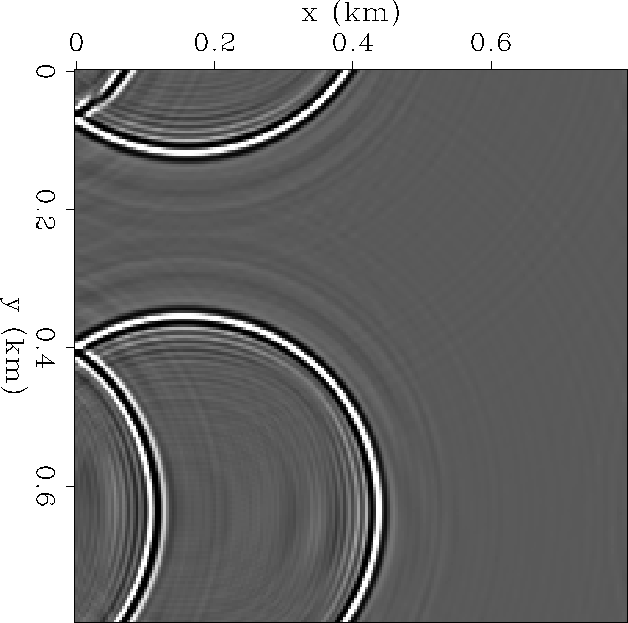
Figure shows the effects of the different boundary
conditions on the two spatial axes. The fast spatial axis (top and
bottom of Figure) have helical boundary conditions, and show
wrap-around. The slow spatial axis (left and right of Figure) has
a zero-value boundary condition, and hence is reflective.
For the examples in this chapter, we set the `one-sixth'
parameter Claerbout (1985),  , and used the isotropic
nine-point Laplacian from equation () that corresponds
to
, and used the isotropic
nine-point Laplacian from equation () that corresponds
to  in equation ().
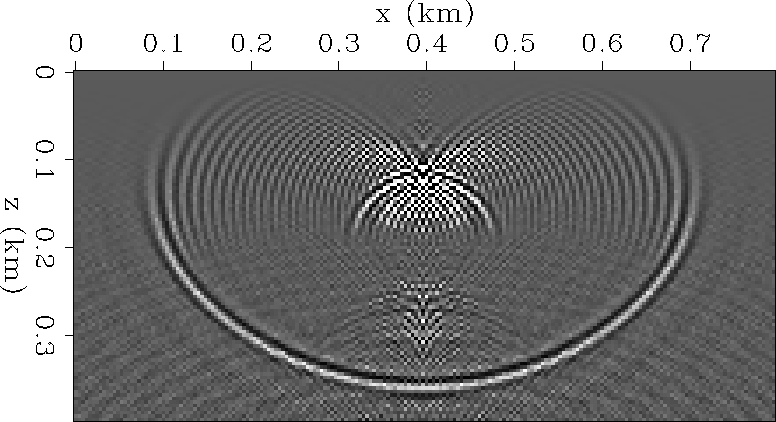 |
wave equation, showing the
distinctive cardioid.


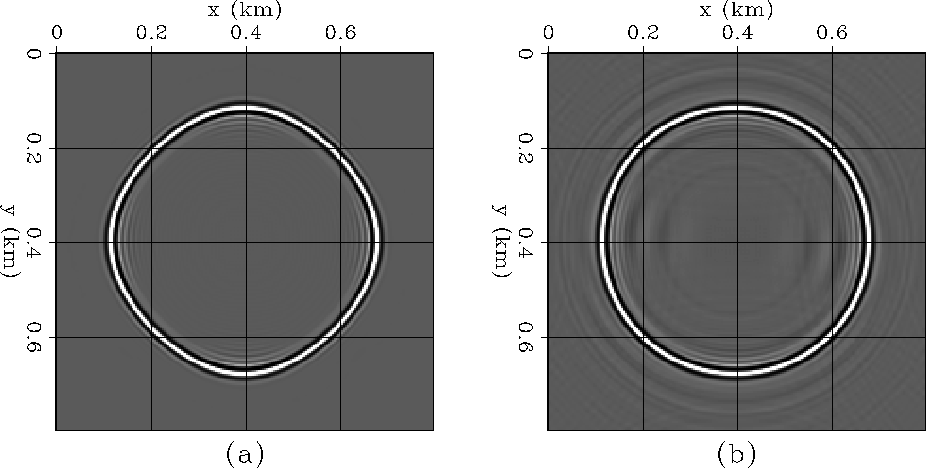 |
. Panel (a) shows the result of
employing an x-y splitting approximation, and panel (b)
shows the result of the helical factorization. Note the azimuthally
isotropic nature of panel (b).
Evanescent energy has been removed by dip-filtering prior to
migration.
![[*]](http://sepwww.stanford.edu/latex2html/movie.gif)
|
3Dboundary
Figure 3 Depth-slice of offset impulse response corresponding to a dip of 45 . Note the helical boundary conditions on the fast spatial
axis.
|  |