


 |
(61) |
 |
(62) |
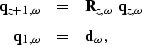
 , these equations can be rewritten in matrix form
as
, these equations can be rewritten in matrix form
as
 |
(63) | |
| (64) |
 is a single frequency component of data
recorded at the surface,
is a single frequency component of data
recorded at the surface,  is a vector containing a
single frequency component of the wavefield at depth-step, z, and
is a vector containing a
single frequency component of the wavefield at depth-step, z, and
 is the corresponding extrapolation operator.
If the downward-continuation operator, , contains
purely a phase-shift, then its adjoint,  will
fully describe the inverse process of upward-continuation.
However, for the amplitudes to be treated accurately,
must respect the physics of wave propagation.
Stolt and Benson (1986) show that v(z) extrapolators based on WKBJ
Green's functions contain an amplitude term as well as a phase term,
and for v(x,y,z) earth models this effect is even more pronounced.
So while kinematically-correct extrapolators are
pseudo-unitary, true-amplitude depth extrapolators are not.
In this introductory section, I follow conventional seismic processing
methodology, and treat the depth extrapolator as a unitary operator;
however, in section
will
fully describe the inverse process of upward-continuation.
However, for the amplitudes to be treated accurately,
must respect the physics of wave propagation.
Stolt and Benson (1986) show that v(z) extrapolators based on WKBJ
Green's functions contain an amplitude term as well as a phase term,
and for v(x,y,z) earth models this effect is even more pronounced.
So while kinematically-correct extrapolators are
pseudo-unitary, true-amplitude depth extrapolators are not.
In this introductory section, I follow conventional seismic processing
methodology, and treat the depth extrapolator as a unitary operator;
however, in section ![[*]](http://sepwww.stanford.edu/latex2html/cross_ref_motif.gif) , I discuss how to model
amplitudes correctly.
, I discuss how to model
amplitudes correctly.
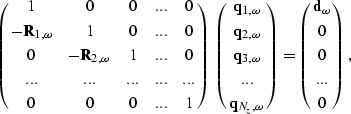
The recursion in equations () and ()
can be rewritten as:
 |
(65) |
 |
(66) |
 now contains for all
depth-steps,
now contains for all
depth-steps,  is a zero-padding operator, and
 is the extrapolation matrix in
equation () that can be inverted rapidly by
recursion.
is the extrapolation matrix in
equation () that can be inverted rapidly by
recursion.
Equation () encapsulates the idea that we can
reconstruct the wavefield at every depth-step in the earth from the
wavefield at the surface by inverting matrix, .
As a final step, to produce a migrated image we need to invoke an
imaging condition. For the case of exploding-reflector (zero-offset)
migration [e.g. Claerbout (1995)], we need to extract the image,
 , corresponding to t=0.
In the temporal frequency domain, we can do this by summing
over frequency. This stacking process is described by the matrix
equation,
, corresponding to t=0.
In the temporal frequency domain, we can do this by summing
over frequency. This stacking process is described by the matrix
equation,

 |
(67) |
 is the reflectivity model,
  is the total
wavefield,
is the total
wavefield,  is the identity matrix of rank N,
and
is the identity matrix of rank N,
and  is the (exploding-reflector) imaging operator
that sums over frequencies.
is the (exploding-reflector) imaging operator
that sums over frequencies.
The process of imaging by exploding-reflector migration can then be summarized as the chain of composite operators:
 |
(68) |
