


![[*]](http://sepwww.stanford.edu/latex2html/cross_ref_motif.gif) ) to deal with non-stationarity.
The simplest approach Yilmaz (1987) is to apply multiple stationary
filters and interpolate the results. This approach, however, gives
incorrect spectral response in the interpolated areas Pann and Shin (1976).
) to deal with non-stationarity.
The simplest approach Yilmaz (1987) is to apply multiple stationary
filters and interpolate the results. This approach, however, gives
incorrect spectral response in the interpolated areas Pann and Shin (1976).
Following Claerbout (1998a) and Margrave (1998), I extend the
concept of a filter to that of a filter-bank, which
is a set of N filters: one filter for every point in the
input/output space.
I identify  with the filter corresponding to the
 location in the input/output vector, and the coefficient,
ai,j, with the
location in the input/output vector, and the coefficient,
ai,j, with the  coefficient of the filter,
.
coefficient of the filter,
.
Margrave (1998) describes two closely related alternatives which
both reduce to normal convolution in the limit of stationarity.
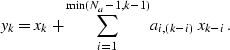
The first approach is to place the filters in the columns of the
matrix,  . This associates a single filter with a single
point in the output space, and defines non-stationary
convolution:
. This associates a single filter with a single
point in the output space, and defines non-stationary
convolution:
 |
(116) |
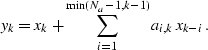
, associating a single filter with a
single point in the input space. This defines what
Margrave (1998) refers to as non-stationary
combination:
 |
(117) |
) to an
impulse at the element of  , is .
A more general output is then a scaled superposition of filter-bank
filters, which fits with Green's function theory for linear, constant
coefficient, partial differential equations.
Again, in contrast, the response of equation () to an
impulse at the element of , is the column of non-stationary combination matrix, which bears no direct
relationship to the filter, , or any other individual
filter for that matter.
, is .
A more general output is then a scaled superposition of filter-bank
filters, which fits with Green's function theory for linear, constant
coefficient, partial differential equations.
Again, in contrast, the response of equation () to an
impulse at the element of , is the column of non-stationary combination matrix, which bears no direct
relationship to the filter, , or any other individual
filter for that matter.
As an illustration, consider the differences between matrices,
 and
and  below, which
represent, respectively, non-stationary convolution and
combination with a causal three-point (Nf=3) filter-bank,
below, which
represent, respectively, non-stationary convolution and
combination with a causal three-point (Nf=3) filter-bank,
 , to vectors of length, N=5. The two are equivalent in the
stationary limit; however, while the columns of
contain filters,
, to vectors of length, N=5. The two are equivalent in the
stationary limit; however, while the columns of
contain filters,  , the columns of
do not.
, the columns of
do not.
![\begin{displaymath}
{\bf F}_{\rm conv} =
\left[ \begin{array}
{ccccccc}
1 & 0 & ...
...1 & 0 \\ 0 & 0 & 0 & f_{25} & f_{15} & 1 \\ \end{array} \right]\end{displaymath}](img285.gif)
and
are related, they are not simply adjoint to each
other.