


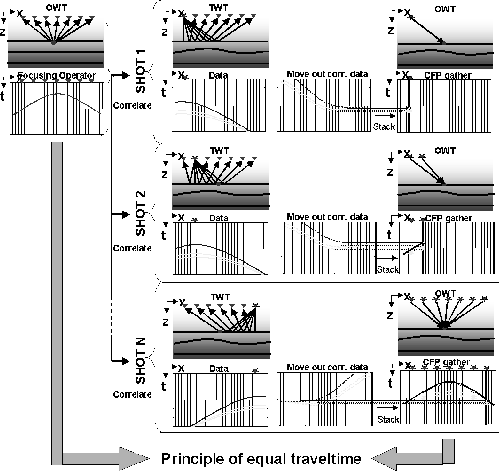
The first focusing step is performed by time-convolving a shot record with the focusing operator of the point under consideration. Next, all traces in the obtained move-out corrected shot record are summed (consider shot 1 in Fig.1). When this first focusing step is applied to all shots, each shot record is transformed into a single trace by the focusing operator (consider shot 1,2-n in Fig.1). Together those traces define the so-called common focus point gather (CFP-gather). Each trace in the CFP gather is positioned at the source position of its corresponding shot record. One event in the CFP-gather is the focus point response. If the velocity model is correct, the focus point response and the time-reversed focusing operator (= Green's function) have equal traveltime: principle of equal traveltime (Fig.1).
Note that the first focusing step "transforms" conventional two way data to one way CFP data. The second focusing step is performed by applying the focusing operator again. This procedure transforms the focus point response into the seismic image of the subsurface grid point under consideration (CFP-stacking). In this report only the first step is considered, because this is the required step for obtaining focusing operators as will be shown in the next section.
 |
