


 by application to a reference model (
 )
by measuring its effects when applied to a reference model ().
)
by measuring its effects when applied to a reference model ().
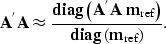
The approximation is then evaluated as
 |
(11) |
,but it just requires its application to a reference model.
Of course, the resulting approximation is strongly
dependent from the choice of the reference model.
The closer is the reference model to the true model,
the better is the approximation.
In theory, if the reference model is equal to the true model
we will achieve perfect results.
It is also easy to show that the approximation of
by the sum of its columns,
equation (10),
is equivalent
to the choice of a constant vector
as in equation (11).
Therefore, it will bias the imaging process towards
model that are constant.
In the case of stacking, it encourages flat reflectors,
that is consistent with the flat reflector assumptions
underlying the stacking process.
In the case of a more complex imaging
operator aimed at imaging complex structure,
this bias towards flat reflectors may be less appropriate.
Fold normalization is effective when the geometry is irregular but without sizable data gaps. However, when these gaps are present the normalization weights tend to become large. Even if instability can be easily avoided by the weights modification expressed in equation (7), gaps are going to be left in the uniformly sampled data. These gaps are likely to introduce artifacts in the image because migration operators spread them as migration smiles. The gaps should be filled using the information from nearby traces before migration. In the next section we discuss how that can be done within the context of inverse theory.