


Stolt 1996 first introduced prestack residual migration. Sava 1999 reformulated Stolt residual migration in order to handle prestack depth images. This section presents the extension of Sava (1999) for two different wavefields, therefore, two different velocities. We present this extension for converted waves data, where the P to S conversion occurs at the reflector. Although the formulation involves P-velocities and S-velocities, its application is not limited to converted waves only. Rosales and Biondi (2001) present a possible application for imaging under salt edges.
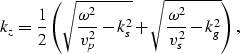
Residual prestack Stolt migration operates in the Fourier domain. Considering the representation of the input data in shot-geophone coordinates, the mapping from the data space to the model space takes the form
 |
(1) |
In residual prestack Stolt migration for converted waves, we attempt to simultaneously correct the effects of migrating with two inaccurate velocity fields.
Supposing that the initial migration was done with the velocities v0p and v0s, and that the correct velocities are vmp and vms, we can then write
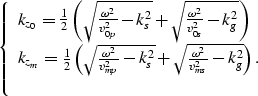 |
Solving for  in the
first equation of (2) and substituting it
in the second equation of (2), we obtain
the expression for prestack Stolt depth residual migration
for converted waves [equations (3) and/or (4)]
(see Appendix A, for details in derivation)
in the
first equation of (2) and substituting it
in the second equation of (2), we obtain
the expression for prestack Stolt depth residual migration
for converted waves [equations (3) and/or (4)]
(see Appendix A, for details in derivation)
 |
(2) |
 |
(3) |
where  is the transformation kernel and
is defined as
is the transformation kernel and
is defined as

and  ,
,  , and
, and  .
.
In equation (2) it appears that
Stolt residual migration for converted waves
depends on four parameters: v0p, v0s, vmp, vms.
These four degrees of freedom can be reduced to three
( ,
,  and
and  ), as seen in
equations (3) and (4) and demonstrated in Appendix A.
This is important,
because a three parameters search for updating converted waves images
is simpler than a four parameters search.
However, it would be useful to further reduce
the number of parameter to two.
Assuming that the vp/vs ratio is the same after and
before the residual migration process, it is possible to simplify
equations (3) and/or (4) into a two
parameter equation:
), as seen in
equations (3) and (4) and demonstrated in Appendix A.
This is important,
because a three parameters search for updating converted waves images
is simpler than a four parameters search.
However, it would be useful to further reduce
the number of parameter to two.
Assuming that the vp/vs ratio is the same after and
before the residual migration process, it is possible to simplify
equations (3) and/or (4) into a two
parameter equation:
 |
(4) |
where the transformation kernel takes the form

If we just specify two different ratios in both square roots of Sava's 1999 formulation we have
 |
(5) |
where the transformation kernel has the same form as the one of PP waves:
![\begin{displaymath}
\kappa_0^2 = \frac{\left[4k_{z_0}^2+(k_g-k_s)^2\right]\left[4k_{z_0}^2+(k_g+k_s)^2\right]}{16 k_{z_0}^2}.\end{displaymath}](img17.gif)
Equation (6) shows another way of doing prestack residual
migration for converted waves.
Although equations (5) and
(6) may look similar because they depend on only two
parameters, the transformation kernels
( and
and  )are different.
Equation
(6) has a similar transformation kernel as the conventional PP
prestack residual migration, while equation (5) presents
a kernel deduced for the case of converted waves.
)are different.
Equation
(6) has a similar transformation kernel as the conventional PP
prestack residual migration, while equation (5) presents
a kernel deduced for the case of converted waves.
It is important to note that all three equations (3), (5),
and (6) reduce to the same expressions in the limit
when of vs tends to vp, or tends to 1.
All of them reduce
to the simple case of prestack residual migration for
conventional PP data. Appendix B demonstrates this result.