


First we calculate the dip. Dip can be easily calculated using a plane-wave destructor as described in Claerbout (1992).
For the dip in the x direction of a seismic cube with a wave field represented by u(x,y,t), at each sample we calculate:
 |
(1) |
 taken on a mesh in (x,t) and t' is
  . Because we are calculating a different dip at each sample, it is necessary to smooth the dips. We apply a triangle filter to both the numerator and denominator of equation (1). Presently, in calculating px, we smooth along the x-axis and t-axis. However, a more robust approach would be to smooth along the x-axis, t-axis, and y-axis.
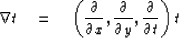
Our main objective is to find an absolute time (t) at each sample in the seismic data cube. Because the dip can be thought of as the gradient ( ), the dip in the x direction (px) is the x component of the gradient. Similarly, the dip in the y direction (py) is the y component of the gradient. Using our integration method described below, we first apply the divergence (
 ) to the gradient. Then we convert to Fourier space where we integrate twice by dividing by the Laplacian. Then we convert back to the time domain. The resulting t can be thought of as the absolute time for each point in the data.
Beginning with our input dip data:
 |
(2) |
 and
and  is all ones for smoothness in time (explained below).
The analytical solution is found with:
![\begin{displaymath}
t \quad \approx \quad FFT^{-1} \left[{FFT \left[ \nabla' \na...
...over { -Z_x^{-1} -Z_y^{-1} -Z_t^{-1} +6 -Z_x -Z_y -Z_t} \right]\end{displaymath}](img9.gif) |
(3) |
 .
.The denominator is the Z-transform of the 3D Laplacian. The zero frequency term of the Z-transform of the denominator is neglected. This means that the resulting surface in space will have an unknown constant shift applied to it. However, by adding the t dimension and assuming the gradient in the t direction to be all ones, we are insuring that the integrated time varies smoothly in the t direction.
Integrating in three dimensions enforces vertical smoothness. The dip in the t direction is all ones. This can be thought of intuitively as imagining that the dip in the x direction is the derivative of x with respect to t. So dip in the t direction is the derivative of t with respect to t, therefore it is always one. By integrating in 3D, we prevent our method from swapping sample positions in time.