


 and
and  , an important parameter needs to be
introduced. Depending on the signal and noise that need to be
attenuated, the two model spaces
, an important parameter needs to be
introduced. Depending on the signal and noise that need to be
attenuated, the two model spaces  and
and  can
have very different units. This difference can basically bias the
inversion toward the noise or the signal if nothing is done to
balance the two models. Therefore, a physically meaningful fitting
goal for the modeling approach is
can
have very different units. This difference can basically bias the
inversion toward the noise or the signal if nothing is done to
balance the two models. Therefore, a physically meaningful fitting
goal for the modeling approach is
 |
(26) |
 is a constant that compensates for differences in the
units of and . This parameter can be seen as a
way of putting the common components of the data in whichever domain
we choose, noise or signal, in the presence of crosstalks.
There is no acceptably simple way to select but by
trial and error, e.g., in Chapter
is a constant that compensates for differences in the
units of and . This parameter can be seen as a
way of putting the common components of the data in whichever domain
we choose, noise or signal, in the presence of crosstalks.
There is no acceptably simple way to select but by
trial and error, e.g., in Chapter ![[*]](http://sepwww.stanford.edu/latex2html/cross_ref_motif.gif) .
One possible strategy, however, consists in computing the ratio of the norm (in a
.
One possible strategy, however, consists in computing the ratio of the norm (in a
 sense) of the two gradients for and as follows:
 |
(27) |
and ,
it is important to have them modeling different parts of the data
space. If they overlap, a regularization operator is needed to improve
the signal/noise separation Nemeth (1996). There are a large
number of operators that can model the signal and noise depending
on the data. For instance, Nemeth et al. (2000) shows that migration
can be used.
PEFs can play this role as well because they have the
inverse spectrum of the data from which they were estimated. As an
illustration, Figure a displays a simple monochromatic
plane wave with a given dip. If a multidimensional PEF is estimated
from this dataset, then the PEF will kill this plane wave
(Figure b). Now, looking at the inverse
impulse response of this filter (i.e., deconvolution) in
Figure c, notice that an event with similar
frequency content and dip than in Figure a is
recovered. Thus, PEFs can serve as either filters when convolved with
the residual (filtering approach) or modeling operators when used with
deconvolution.
PEFs are minimum-phase filters Claerbout (1976); Robinson and Treitel (2000), which makes their inverse (with deconvolution) stable. In the stationary case where one filter is needed, inverse PEFs can play the role of modeling operators, and strategies similar to the one used for the filtering approach can be employed to estimate them. In the non-stationary case, however, the non-stationary deconvolution of minimum-phase filters is not guaranteed to be stable Rickett (2001). This defect prevents us from reliably using inverse non-stationary PEFs as modeling operators.
|
fbpef
Figure 1 Some basic properties of the prediction-error filters (PEF). (a) A PEF is estimated from a dataset. (b) The estimated PEF is convolved with the input data leading to a white residual. (c) A spike is deconvolved with the estimated PEF leading to a pattern close to the input data in (a). | 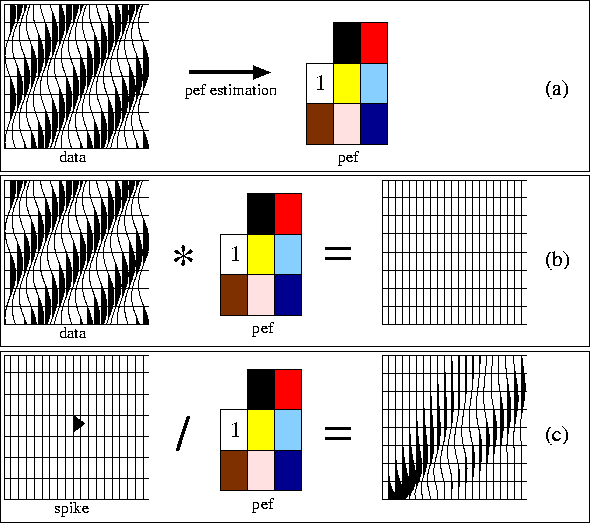 |
