![[pdf]](icons/pdf.png)
|
|
|
|
| Reverse Time Migration of up and down going signal for ocean bottom data | |
|
The derivation for decomposing over/under pressure waves into up-going and down-going signals is best done in the Fourier domain. For a thorough review of this method, please refer to Sonneland et al. (1986). Denote
 and
and
 to be the Fourier-transformed measurements of compressional waves at depths
  (over) and
  (under). Theoretically,
is a sum of the up-going
(under). Theoretically,
is a sum of the up-going
 and down-going
 components. Likewise for
:
components. Likewise for
:
Down-going waves arrive at the under array ( ) before the over (
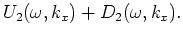 ) array. Therefore, shifting forward in time would match the signal . Similarly, up-going waves visit the over array first. Therefore, shifting
  forward in time would match the signal
  . This relationship is equivalent to a phase-shift in the Fourier domain:
where
 , and
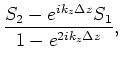
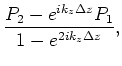
, and 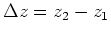 is the usual dispersion relation. Finally, substituting equation 6 into equation 5 yields the formula for the up-going and down-going waves at the receivers:
Over/under acquisition is used to eliminate receiver ghosting and water reverberation. Although over/under arrays are rarely placed on the sea floor in real seismic surveys, this technique allows easy generation of up-going and down-going waves at the sea bottom for synthetic examples or modeling. For the remaining of this paper, we will denote the operation that separates over/under data into up-down data in equation 7 as 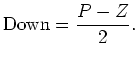 .
.
|
|
|
|
| Reverse Time Migration of up and down going signal for ocean bottom data | |
|