


To apply scattering theory we need to transform the pressure field into a displacement field. The pressure wavefield obeys the scalar wave equation

The P wave displacement  is related to the pressure by the
following expression:
is related to the pressure by the
following expression:

Recalling that the medium (water) is homogeneous and that the displacement
field is irrotational, we can use the relation
 and combine the two previous equations to get
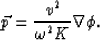
This equation relates the displacement vector field to the scalar pressure field and can be rewritten in the following form:

And after a double spatial Fourier transform, it will be expressed by

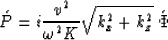
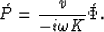
Finally, the displacement amplitude  of the upcoming P wave
on the water can be expressed as a function of the upcoming pressure
field:
of the upcoming P wave
on the water can be expressed as a function of the upcoming pressure
field:
 .
.
Figure ![[*]](http://sepwww.stanford.edu/latex2html/cross_ref_motif.gif) shows how the upcoming P and S waves are scattered
at the ocean bottom interface. The displacement amplitude of the upcoming
pressure field just above the sea floor can be expressed as functions
of the displacement amplitudes of all the incident waves:
shows how the upcoming P and S waves are scattered
at the ocean bottom interface. The displacement amplitude of the upcoming
pressure field just above the sea floor can be expressed as functions
of the displacement amplitudes of all the incident waves:
![\begin{displaymath}
\acute{P_1} = [ \acute{P} \acute{P} ]_{2-1} \acute{P_2} +
[ ...
...2-1} \acute{S_2} +
[ \grave{P} \acute{P} ]_{1-1} \grave{P_1} ,
\end{displaymath}](img28.gif) |
(6) |
![$ [ \acute{P} \acute{P} ]_{2-1} $](img29.gif) is the transmission coefficient
for upcoming P into P waves,
is the transmission coefficient
for upcoming P into P waves, ![$ [ \acute{S} \acute{P} ]_{2-1} $](img30.gif) is the transmission coefficient for upcoming S into P waves
, and
is the transmission coefficient for upcoming S into P waves
, and ![$ [ \grave{P} \acute{P} ]_{1-1} $](img31.gif) is the reflection coefficient for downgoing P into
P waves (Aki and Richards, 1980).
The last term in the previous equation corresponds to the ocean floor
primary reflection and all its associated multiples and peg-legs.
The conditions most suitable for the generation of converted waves in marine
surveys are the same ones that are responsible for the occurrence of
strong multiple contamination. While the ocean floor
primary will not interfere with any converted wave, the multiples
and peg-legs must be removed in order to isolate the PSSP wavefield.
The importance of this step and the method used for its accomplishment
are the subjects of Appendix A.
is the reflection coefficient for downgoing P into
P waves (Aki and Richards, 1980).
The last term in the previous equation corresponds to the ocean floor
primary reflection and all its associated multiples and peg-legs.
The conditions most suitable for the generation of converted waves in marine
surveys are the same ones that are responsible for the occurrence of
strong multiple contamination. While the ocean floor
primary will not interfere with any converted wave, the multiples
and peg-legs must be removed in order to isolate the PSSP wavefield.
The importance of this step and the method used for its accomplishment
are the subjects of Appendix A.
The two remaining terms in equation (6)
(which correspond to the P and S wavefields)
can be reasonably separated by the use of the critical angle for P waves at
the first layer as a discriminant factor (Cunha, 1989),
as illustrated on Figure .
Waves of the type PPPP, PPSP and PSPP will be found only with horizontal
slownesses smaller than the slowness corresponding to the ocean floor
critical angle for P waves (30 degrees on the figure),
while only the PSSP mode will be found at higher horizontal slownesses.
As a first approach we consider that only the dominant mode (PPPP)
is present for pre-critical horizontal slownesses.
Under these assumptions, a ``P-sensible receiver" coupled at the sea bottom would record a displacement
![\begin{displaymath}
\acute{P_2} ={1 \over [ \acute{P} \acute{P} ]_{2-1}} \acute{...
...}for \hspace{1.5cm}$p = {k_x \over \omega} < {1 \over V_p}$}
,\end{displaymath}](img32.gif) |
(7) |
![\begin{displaymath}
\acute{S_2} ={1 \over [ \acute{S} \acute{P} ]_{2-1}} \acute{...
...for \hspace{1.5cm}$p={k_x \over \omega} \geq {1 \over V_p}$}
,\end{displaymath}](img33.gif) |
(8) |