


Next: IRLS algorithm
Up: Lp MINIMIZATION WITH THE
Previous: Lp MINIMIZATION WITH THE
The iterative reweighted least-squares (IRLS) algorithm provides a mean by
which linear systems can be solved by minimizing the Lp norm of the residuals
( ). Let us suppose that we try to solve the set of equations:

To find the Lp solution of this system we minimize the Lp norm
of the residuals:

 is not a norm for p<1, so, for the moment, I will only consider
 . I also omit the exponent 1/p .
To establish the normal equations, we set:
. I also omit the exponent 1/p .
To establish the normal equations, we set:

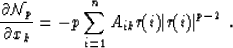
The partial derivatives can be expressed as follows:

where  are the residuals.
Then:
are the residuals.
Then:
|  |
(1) |
To form the normal equations we can now replace r(i) by its expression:

or, after some reorganization:
|  |
(2) |
There are m such equations (k=1 to m). They can be expressed shortly in a
matrix formulation:
|  |
(3) |

and finally:
|  |
(4) |
This formulation is implicit and non-linear since the residuals r(i), and
so the matrix W, depend on the unknown vector x. However, for the classical
least-squares inversion (p=2), W is the identity matrix, and
equation (4) is the usual least-squares equation:
|  |
(5) |
Next: IRLS algorithm
Up: Lp MINIMIZATION WITH THE
Previous: Lp MINIMIZATION WITH THE
Stanford Exploration Project
1/13/1998