


Next: RATE OF CONVERGENCE
Up: Jedlicka: Cascaded normal moveout
Previous: PARTIAL NORMAL MOVEOUT
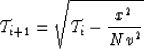
Let us write
|  |
(15) |
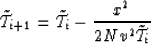
for the nontruncated case and
|  |
(16) |
for the truncated case.
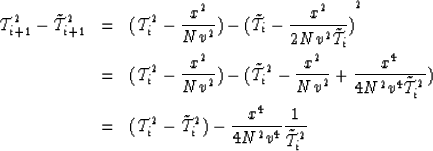
We will estimate the difference  and show that this difference tends to zero as
  .We can write
|  |
(17) |
| (18) |
| (19) |
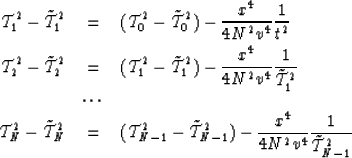
As we did in the previous section, we can rewrite this equation into a
system of equations:
|  |
(20) |
| (21) |
| (22) |
| (23) |
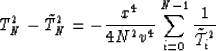
By summing up all these equations we get
|  |
(24) |
Now we need to prove that there exists a constant K independent of N such that
|  |
(25) |
for all  .From equation (16) we can see that
|  |
(26) |
Similarly from equation (24) we can see that
|  |
(27) |
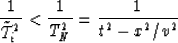
Putting both equations together we have
|  |
(28) |
or
|  |
(29) |
where the last equation follows from equation (14).
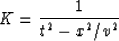
If we define
|  |
(30) |
then from equation (24) we have
|  |
(31) |
which tends to zero as .This proves that the Nth partial normal moveout applied N times is equal
to the normal moveout for large N.
The convergence of cascaded NMO to a semicircle can be clearly seen
on Figure ![[*]](http://sepwww.stanford.edu/latex2html/cross_ref_motif.gif) a. The proof of convergence holds for
a. The proof of convergence holds for  .
The behavior for x/v = t can be seen from sequences at the sides of
Figure b. The figure convinces us that there is convergence even
for x/v=t, but that it is extremely slow.
.
The behavior for x/v = t can be seen from sequences at the sides of
Figure b. The figure convinces us that there is convergence even
for x/v=t, but that it is extremely slow.
Next: RATE OF CONVERGENCE
Up: Jedlicka: Cascaded normal moveout
Previous: PARTIAL NORMAL MOVEOUT
Stanford Exploration Project
1/13/1998