


As is well known, any solution  of the
equation (30) in case of point source can be expressed in the
form
of the
equation (30) in case of point source can be expressed in the
form
 |
(39) |
 is the fundamental solution of a
correspondent boundary value problem for the equation (30).
is the fundamental solution of a
correspondent boundary value problem for the equation (30).
Fundamental solution is a response of a medium to the
 -function as the source. It is easily understood
that (in case of piecewise smooth media with restricted numbers
of interfaces) consists of some
singularities (discontinuities) that propagates with
correspondence to eiconal's equation (31) and relations
(32) and some very smooth field
-function as the source. It is easily understood
that (in case of piecewise smooth media with restricted numbers
of interfaces) consists of some
singularities (discontinuities) that propagates with
correspondence to eiconal's equation (31) and relations
(32) and some very smooth field  .
.
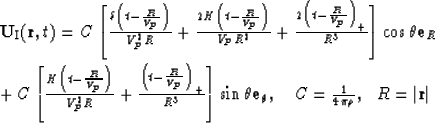
Let us consider a very simple example: a fundamental solution
that corresponds to a point vertical force in a homogeneous
medium (Figure ![[*]](http://sepwww.stanford.edu/latex2html/cross_ref_motif.gif) ) is
) is
 |
(40) |
 |
||
![\begin{eqnarraystar}
{\bf U}_{\rm II}( {\bf r}, t ) & = & -C \left[
{\delta \le...
...over V_s} \right )_+ \over R^3}
\right]
\cos \theta {\bf e}_R.\end{eqnarraystar}](img246.gif) |
||
shows radial (a) and angular (b)
component for some distance R and direction  .
.Let us perform the convolution in equation (39), bearing in mind that
| f(t)*Rq(t) = Iq f(t) = fq(t) | (41) |
 we shall have
 |
||
 , the P-wave has only additional
(transverse!) component. In addition, at
, the P-wave has only additional
(transverse!) component. In addition, at  the S-wave
has only components in the ray direction. But what is indeed
important for convolution of the amplitude of discontinuity of
fundamental solution appears to be an amplitude of the
signal! This is the real reason why discontinuities describe
not only the arrival of a signal, but also the signal
itself: discontinuity is an adequate tool to investigate
fundamental solutions.
the S-wave
has only components in the ray direction. But what is indeed
important for convolution of the amplitude of discontinuity of
fundamental solution appears to be an amplitude of the
signal! This is the real reason why discontinuities describe
not only the arrival of a signal, but also the signal
itself: discontinuity is an adequate tool to investigate
fundamental solutions.
Let  be the observed field
(
be the observed field
( or
or  )
that is given on the surface of observation
)
that is given on the surface of observation
 and
and  is a linear operator that transforms the
function into the field
is a linear operator that transforms the
function into the field  in the adjacent
domain
in the adjacent
domain 

and
can be scalar or vectorial.
The coordinates (x,y) can be curvilinear and the surface of
observation can also be curved.
The action of the operator depends on the choice of the
function  which in turn
is a parameter in a fixed eikonal equation
which in turn
is a parameter in a fixed eikonal equation
 |
(42) |

 is a vector-function.
For instance, in a medium with elliptic anisotropy, we have
is a vector-function.
For instance, in a medium with elliptic anisotropy, we have

 is a positive matrix.
We don't demand that the eikonal equation (42) is a characteristic equation of some hyperbolic differential operator. It is given, that's all!
Let us suppose that the field contains a
discontinuity  (of some order q) with a travel time curve
  .It means that in a neighborhood of the surface
![\begin{displaymath}
u_0({\bf r}_0,t) \sim A_0({\bf r}_0) R_q[t-\tau_{0}({\bf r}_0)].\end{displaymath}](img268.gif)
Generally speaking then, the wave field will contain one or
several discontinuities (with orders not necessarily equal to q)
and at least one of them will coincide with at  .If the position of this discontinuity is described by a
function
.If the position of this discontinuity is described by a
function  , then
 |
(43) |
We shall call the operator a kinematically-equivalent
operator of wave field continuation (on short K-operator, KO) if
the field necessarily contains at least one
discontinuity with eikonal , that satisfies
equations (42) and (43) simultaneously.
The notion of K-operator may be expanded to the case when both
fields and are vectorial fields.
In that case we have two equations (isotropic case) or three
equations (anisotropic case):
 |
(44) |
has a discontinuity with i-th
polarization at , then application of a K-operator
will result in the presence of discontinuity of the
field  which:
 .
.The question of existence of a K-operator corresponding to a given equation (42) can be simply answered (in a positive sense) if equation (42) is a characteristic equation for some equation in partial derivatives:
 |
(45) |
Let us consider the boundary value problem for equation (45) with condition
 |
(46) |
 |
(47) |
It is obvious that the solution contains at least one discontinuity
which at coincides
with and propagates with the eikonal
satisfying equation (42).
Later we shall show that KO exists for any equation (42) if there
is a solution for the Cauchy problem for equation (42) with
the initial condition (43).
As a matter of fact there is a whole family  of
K-operators that corresponds to the particular eikonal equation (42).
of
K-operators that corresponds to the particular eikonal equation (42).
K-equivalence is a notion which is much wider than
q-equivalence or (k)-equivalence. For instance, if  belong to the same family , then it is not
necessary that
belong to the same family , then it is not
necessary that

 and
and  can have different
orders and amplitudes of discontinuities (and even their number)
which satisfy the equations (42) and (43).
can have different
orders and amplitudes of discontinuities (and even their number)
which satisfy the equations (42) and (43).
Let us consider K-operators for the classical eikonal equation
 |
(48) |
| |
(49) |

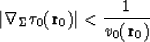
 ),
then in a neighbourhood of the surface
),
then in a neighbourhood of the surface  there are
two solutions for this problem:
there are
two solutions for this problem:  and
and  . In order to prove this we shall search for
solution of the problem (48) - (49)) using
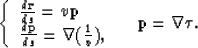
characteristics of equation (48). Characteristics of the
equation (48) (that is rays, or
characteristics of the proper wave equation (45)) satisfy
to the first order differential equation
. In order to prove this we shall search for
solution of the problem (48) - (49)) using
characteristics of equation (48). Characteristics of the
equation (48) (that is rays, or
characteristics of the proper wave equation (45)) satisfy
to the first order differential equation
 |
(50) |
In order to get a unique solution of the equation (50) it is
necessary (and sufficient) to have a definite value
 in a starting point .We can express the vector
  in the form of a sum

 is a normal to at the point ,
and
is a normal to at the point ,
and  (instead of
 we shall write
  ).
The value
).
The value  can be expressed
through the derivatives of the function
can be expressed
through the derivatives of the function  .
If is a horizontal plane and x and y are rectangular
coordinates, then
.
If is a horizontal plane and x and y are rectangular
coordinates, then

 means gradient in the plane
and
means gradient in the plane
and  and
and  are unit vectors.
Let us consider the case when is a curved surface and x and
y are a curvilinear system of coordinates. We propose that the axis
z coincides with the direction of a vector .
Let us determine a tangent plane P to in
the point and let's introduce
the rectangular coordinates  and
and  in P, then



 . So,
. So,

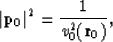
 ), then
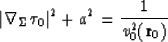
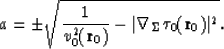
We have obtained that

which will be
called forward eikonal continuation . The sign ``-'' determines
reverse eikonal continuation , (the relationship of
these continuations is shown in Figure ).
It is easily understood that  where
where
 is the time of propagation
from to
is the time of propagation
from to  .We shall call K-operator as the K-operator of forward (reverse)
wave field continuation and denote it as
.We shall call K-operator as the K-operator of forward (reverse)
wave field continuation and denote it as  (similarly
 ) if in the neighbourhood of the field

 ) contains a discontinuity with eikonal
 (
(  ) and does not contain a discontinuity with
the opposite eikonal () .
) and does not contain a discontinuity with
the opposite eikonal () .
Each operator  can be used for determination of the operator
 |
(51) |
 . And vice versa:

There are, of course, such K-operators that contain (in a neighbourhood
of ) discontinuities with both eikonals and (mixed type operators).
This classification of K-operators may be expanded
for many other eikonal equations.
The classes of this classification are still very wide. If
operators  and
and  belong to the same
class (forward, reverse or mixed) of K-operators and for some k
belong to the same
class (forward, reverse or mixed) of K-operators and for some k
 |
(52) |
 is a solution of a transport equation for the definite wave equation, for
instance at
is a solution of a transport equation for the definite wave equation, for
instance at  (classical wave equation). In the latter case discontinuity's amplitudes change with accordance to geometrical spreading (as ray's
amplitudes). If in
equation (52)
k=0 we have dynamic equivalence.
(classical wave equation). In the latter case discontinuity's amplitudes change with accordance to geometrical spreading (as ray's
amplitudes). If in
equation (52)
k=0 we have dynamic equivalence.