


To test the performance of the algorithm in inverting
data generated in a 2-D medium, we computed synthetic traveltimes
through the isotropic model shown in Figure ![[*]](http://sepwww.stanford.edu/latex2html/cross_ref_motif.gif) .
The separation between contiguous
sources and receivers is 10 ft and for each receiver gather,
only sources located at
.
The separation between contiguous
sources and receivers is 10 ft and for each receiver gather,
only sources located at  degrees are used. With a geometry
like this, we pretend to simulate
the geometry of the real data example to be analyzed
later. As in the 1-D example, the slowness contrast between the anomaly
and the background is small (
degrees are used. With a geometry
like this, we pretend to simulate
the geometry of the real data example to be analyzed
later. As in the 1-D example, the slowness contrast between the anomaly
and the background is small ( ), and therefore,
straight rays can be used again.
), and therefore,
straight rays can be used again.
|
s-model-test
Figure 7 Isotropic slowness model. The radius of the circular anomaly is r=50 and is centered at (100,700). The background slowness is 1.0 and the slowness of the disc is 1.05. | 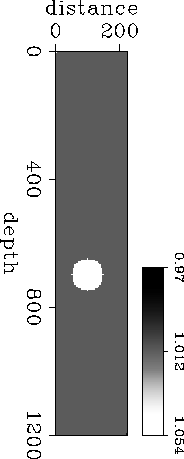 |

 |
The unknown model was discretized in 241 x 46 pixels (5 ft2)
and therefore,
the inversion has to estimate 241 x 46 x 2 parameters from
2200 synthetic traveltimes.
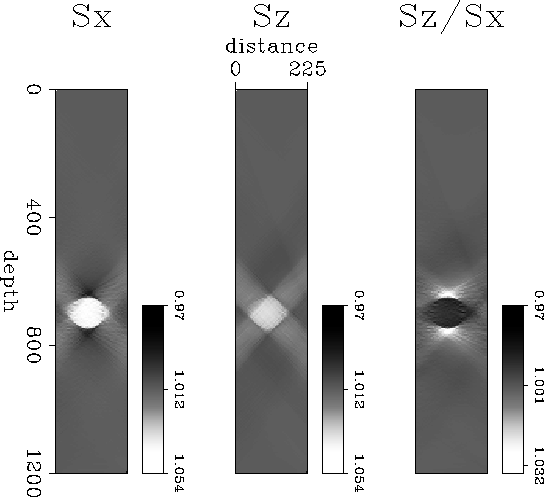
Figure shows the results of the inversion.
The slowness
of the isotropic circular anomaly (1.05) is better estimated by
the horizontal than by the vertical component of the slowness. Remember
that this is not the case in the 1-D inversion, where both slowness
components can be perfectly recovered even thought the vertical
component of the slowness is not properly sampled. The
extra information introduced in that problem by assuming that
the model is layered compensates for the
limited view of the measurements.
In the
2-D inversion, where the unknown is less constrained, the better sampling of the
horizontal component
translates into a better
recovery of that component and as a result, some
artificial anisotropy is introduced by the reconstruction. In this
noise-free example
such an anisotropy
is not greater than  as shown in Figure
by the ratio
as shown in Figure
by the ratio  .Doing more CG-iterations does not help to reduce
this artificial anisotropy to zero, like in the 1-D inversion (Figures 5 and 6).
In the present case
the images didn't change after 120-CG iterations.
.Doing more CG-iterations does not help to reduce
this artificial anisotropy to zero, like in the 1-D inversion (Figures 5 and 6).
In the present case
the images didn't change after 120-CG iterations.
The artifacts in both slowness components are similar to the well known truncation artifacts in isotropic inversion although they are different from one component to the other. The estimated Sx is smeared along the horizontal direction whereas Sz is not. This is because the estimation of Sz is not affected by rays that travel horizontally. The different character of the artifacts for each slowness component can limit our ability to recover variations in anisotropy at the same scale of variations in velocity when data from only one geometry is used. This will be clearly observed later in the application to field data.