


In areas with weak lateral velocity variation, it has long been known that time migration followed by time-to-depth conversion is a good approximation for full prestack depth migration in a kinematic imaging sense, and is at least an order of magnitude more efficient. I claim the same is true for migration/inversion in a dynamic sense, where time migration approximations are used for the amplitude and ray dynamic variables as well as the standard kinematic approximations. Not everyone agrees (e.g., Berkhout, 1992, EAEG discussion period following the presentation by Lumley and Biondi, 1992).
In this study, I show the results of efficient time migration/inversion
in a velocity model of weak lateral variation. I factor the WKBJ
amplitudes A into components of source/receiver directivity and strength,
geometric divergence, transmission loss, and intrinsic Q attenuation.
In this example I implement WKBJ amplitude compensation for only
source/receiver directivity and geometric divergence, assuming
attenuation due to transmission and Q is negligible here.
I represent the air-gun source with a  directivity to
account for the free-surface and array effect. I represent the receiver
directivity as
directivity to
account for the free-surface and array effect. I represent the receiver
directivity as  to account for the free-surface and
hydrophone group effect. These directivity patterns are input parameters
to be freely chosen by the user depending on source and receiver type,
and whether marine or land acquisition.
to account for the free-surface and
hydrophone group effect. These directivity patterns are input parameters
to be freely chosen by the user depending on source and receiver type,
and whether marine or land acquisition.
I estimate the ray angles as follows. In a constant velocity earth, the straight raypath angle is given simply as:
 |
(10) |
where  is vertical migration pseudodepth, and t is migration
hyperbolic traveltime. For the case of an rms time migration velocity
field
is vertical migration pseudodepth, and t is migration
hyperbolic traveltime. For the case of an rms time migration velocity
field  , I make the approximation that the take-off angle
at the source or receiver surface is given by:
, I make the approximation that the take-off angle
at the source or receiver surface is given by:
![\begin{displaymath}
\cos\theta_{s,r} \approx \left[ \cos\theta_0 \right]^{+q} \;, \end{displaymath}](img52.gif) |
(11) |
and the incident angle at the subsurface image point is:
![\begin{displaymath}
\cos\theta_i \approx \left[ \cos\theta_0\right]^{-q} \;,\end{displaymath}](img53.gif) |
(12) |
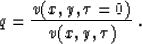
where the exponent q is defined as:
 |
(13) |
For the divergence compensation, I use the standard geometric spreading
approximation in an rms velocity field :
 |
(14) |
These approximations are then used in the prestack migration/inversion
to compute the gradient and Hessian terms of equations
(4) and (5), resulting in final
prestack time estimates of  and
and  .
These are then easily converted to depth by a simple vertical stretch
algorithm in weakly lateral variable media, or by reverse-time
extrapolation through an interval velocity model with strong
time migration lateral positioning errors. Of course, in strong
v(x) media, time migration may not be appropriate at all even in
a kinematic sense. However, many reservoir and exploration situations
satisfy the time migration approximations well.
.
These are then easily converted to depth by a simple vertical stretch
algorithm in weakly lateral variable media, or by reverse-time
extrapolation through an interval velocity model with strong
time migration lateral positioning errors. Of course, in strong
v(x) media, time migration may not be appropriate at all even in
a kinematic sense. However, many reservoir and exploration situations
satisfy the time migration approximations well.