


![[*]](http://sepwww.stanford.edu/latex2html/cross_ref_motif.gif) .
For conj==0 causal integration is followed by anticausal integration and
for conj==1 anticausal integration is followed by causal integration.
This strategy for creating triangular weighting functions along the operator
trajectory by double integration is applied to 3-D migration by
Lumley 1993 and
to 3-D DMO by Blondel 1993.
Theoretical aspects of anti-aliasing and integration along a line are
discussed by Nichols 1993.
.
For conj==0 causal integration is followed by anticausal integration and
for conj==1 anticausal integration is followed by causal integration.
This strategy for creating triangular weighting functions along the operator
trajectory by double integration is applied to 3-D migration by
Lumley 1993 and
to 3-D DMO by Blondel 1993.
Theoretical aspects of anti-aliasing and integration along a line are
discussed by Nichols 1993.
The main issue of this report is to analyze the difference between using
causintold() and causintnew() . In the last report we used
causintnew(), but earlier algorithms which
perform similar operations with trimo() use
causintold() Claerbout (1992).
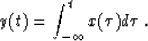
Causal integration is defined as
![\begin{displaymath}
\left[
\begin{array}
{c}
y_0 \\ y_1 \\ y_2 \\ y_3 \\ y...
... x_5 \\ x_6 \\ x_7 \\ x_8 \\ x_9 \\ \end{array} \right]
\end{displaymath}](img2.gif) |
(1) |
. With 1/2 on the diagonal
the summation  is exactly true, so it seems that causintnew() is an improvement
over causintold() which has 1 on the diagonal.
is exactly true, so it seems that causintnew() is an improvement
over causintold() which has 1 on the diagonal.
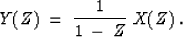
In terms of Z-transforms, causintnew() is represented by the bilinear transform
 |
(2) |
 |
(3) |
Both Equations have poles at Z = 1, corresponding to  .Equation (2) has a zero at Z = -1 which is the Nyquist
frequency
.Equation (2) has a zero at Z = -1 which is the Nyquist
frequency  . The result of putting the zero in the
numerator of equation (2) is that causintnew() acts
to low-pass filter the input signal more than causintold().
. The result of putting the zero in the
numerator of equation (2) is that causintnew() acts
to low-pass filter the input signal more than causintold().
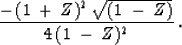
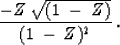
The net effect of modeling with causintnew(), including half-order differentiation can be represented in terms of Z-transform as multiplication by
 |
(4) |
 |
(5) |
Figure 1 illustrates the actions of causintold() and causintnew(). Triangles are created by integrating three spikes causally and then anticausally. The triangle created by double application of causintold() is plotted on the second line of Figure 1. It is sharper and narrower than the triangle created by double application of causintnew and displayed on the third line of Figure 1. The last two lines in Figure 1 are the result of the application of equations (5) and (4). The application of causintnew to implement equation (4) results in a smoother and broader phase shifted triangle.
The effect of using causintnew is to low-pass filter the result which is obtained by using causintold(). This effect is even more evident when the routines are used in conjunction with kfastaax() on synthetic data.
|
caus
Figure 1 The first line is the input to the double causal integration subroutine. Second and third lines are triangles created by applying double integration using causintold() and causintnew(). The fourth and fifth lines are the result of applying the half-order differential before double integration. The triangles created with causintold() are narrower and sharper than the ones created with causintnew(). | 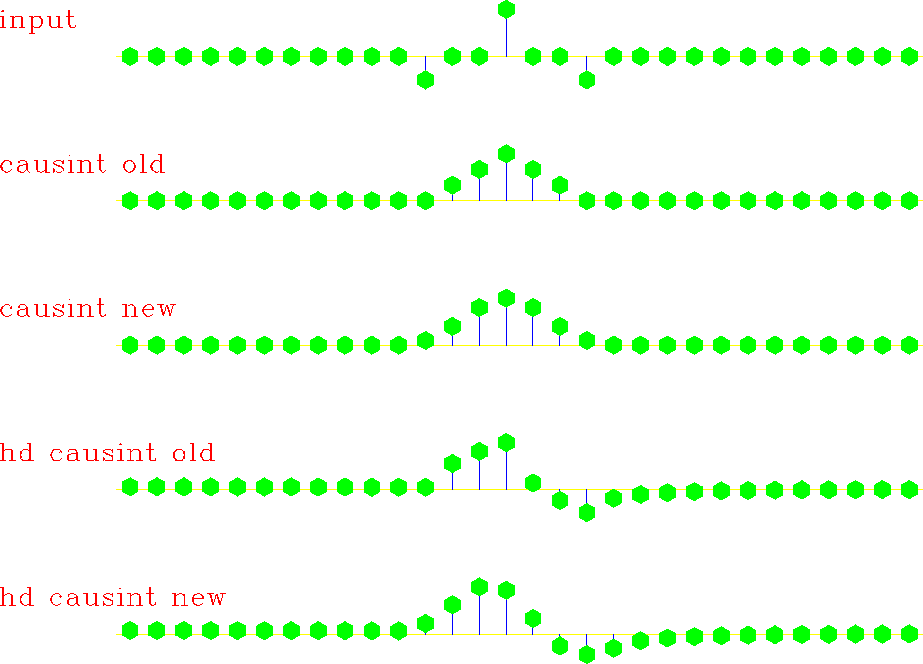 |


