Next: CONCLUSIONS
Up: ESTIMATION OF NEAR SURFACE
Previous: Slant stack imaging
Ultimately, I would like to input an initial image from this slant stack
result into a downward continuation program as a first guess at the
velocity structure. This first guess could then be refined using an iterative
method. The criteria for when a satisfactory velocity has been converged
upon could then be the elimination of the ``X'' patterns and/or hyperbolic
trajectories in shot or offset space. Both these criteria are essentially the
same and will be satisfied when an adequate velocity is converged upon.
syndn
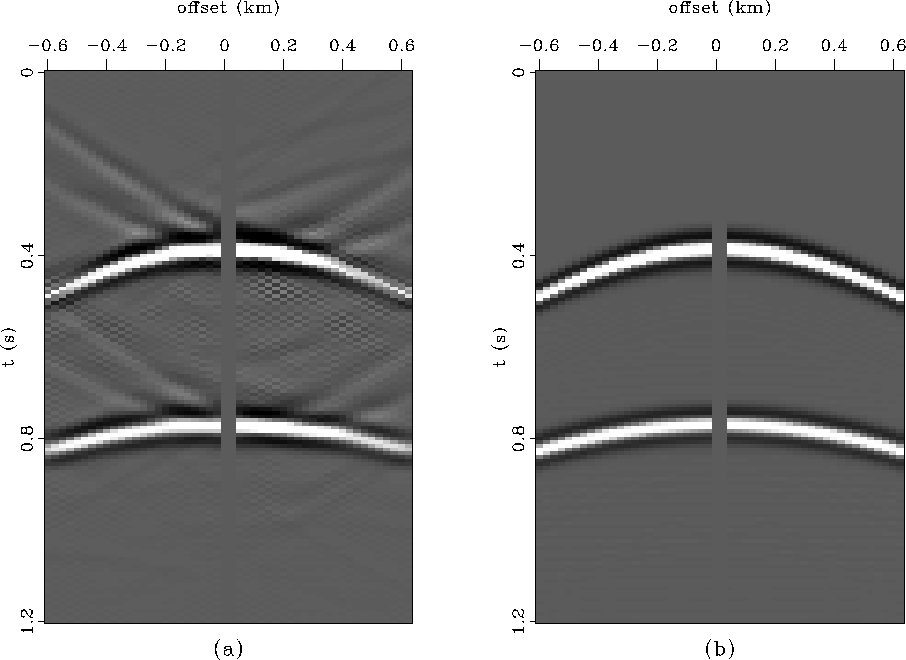
Figure 6 Comparison of (a) a synthetic shot gather downward continued through the
velocity perturbation with the exact velocity model and (b) the original
synthetic data.


At the time of this writing, I am not ready to input the result of the
slant stack code into the downward continuation code; However, I can demonstrate
how the distortions due to the velocity perturbation can be removed.
In Figure 6a I have taken the data from Figures 2b and
3 and downward continued through the exact velocity model.
The effect of the velocity perturbation is removed.
The kinematics are restored but some artifacts and amplitude effects remain.
This downward continuation is performed using the Kirchhoff code discussed
earlier. In order to parameterize velocity it will be more convenient to
perform the wavefield extrapolation by using a finite-difference code or
by calculating finite-difference traveltimes for the Kirchhoff scheme.
Next: CONCLUSIONS
Up: ESTIMATION OF NEAR SURFACE
Previous: Slant stack imaging
Stanford Exploration Project
11/16/1997