


![[*]](http://sepwww.stanford.edu/latex2html/cross_ref_motif.gif) , I describe how conventional Kirchhoff imaging with
single-valued first arrivals breaks down in complex velocity models,
and more importantly, I present a method of surmounting the problem.
I combine Kirchhoff datuming
with prestack Kirchhoff depth migration in an efficient layer-stripping
depth migration algorithm and show how this approach yields
excellent images in a realistic velocity model with extreme lateral velocity
variations.
The method is fairly robust even when the exact velocity model is not
known, and it produces a better image than standard Kirchhoff implementations
using most energetic traveltimes and band-limited traveltimes.
, I describe how conventional Kirchhoff imaging with
single-valued first arrivals breaks down in complex velocity models,
and more importantly, I present a method of surmounting the problem.
I combine Kirchhoff datuming
with prestack Kirchhoff depth migration in an efficient layer-stripping
depth migration algorithm and show how this approach yields
excellent images in a realistic velocity model with extreme lateral velocity
variations.
The method is fairly robust even when the exact velocity model is not
known, and it produces a better image than standard Kirchhoff implementations
using most energetic traveltimes and band-limited traveltimes.
The method alternates steps of datuming and imaging. Because traveltimes are computed for each step, the adverse effects of caustics and headwaves do not develop. The method is semi-recursive because the wavefield is downward continued and re-synthesized at multiple depth levels. When the imaging problem is divided in this way, the traveltimes are better behaved and some multiple arrivals are accounted for.
The great appeal of this approach is that it combines the efficiency of first-arrival Kirchhoff imaging with excellent image quality. In principle, this method only requires the same number of traveltime calculations as a standard migration. The Kirchhoff datuming steps can be implemented so that they are much more efficient than Kirchhoff migration. Therefore, the total cost of the algorithm is only a few times more than that of standard first-arrival Kirchhoff migration.
The Marmousi synthetic data set has been a popular
testbed for seismic velocity estimation and imaging algorithms
and it has been demonstrated that Kirchhoff algorithms using
first arrival traveltimes fail even when the correct velocity
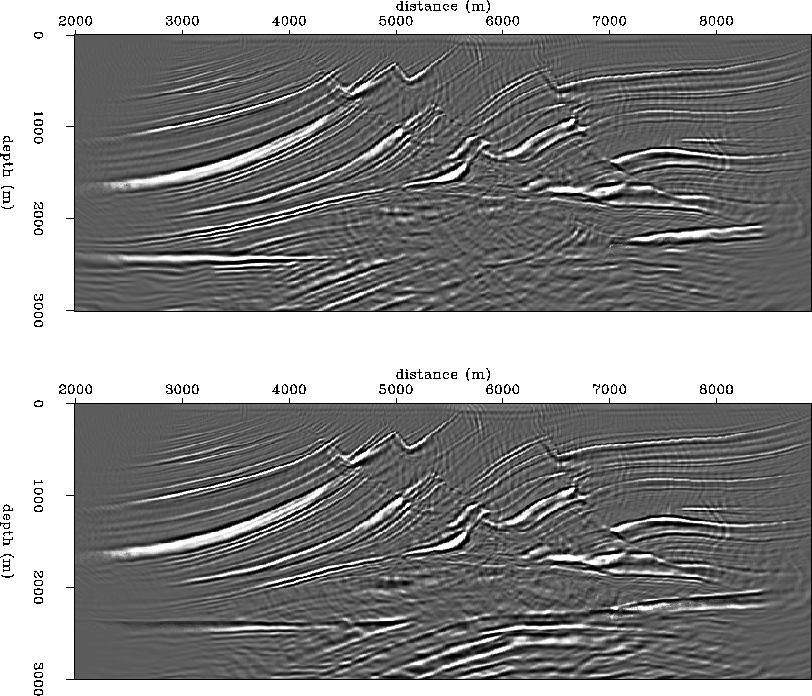
model is used. This failure is illustrated in the
top panel of Figure .
This type of failure is disappointing because Kirchhoff migration is
the most popular 2-D and 3-D prestack imaging method.
This failure has stimulated the development of more accurate
traveltime calculation methods that aim to handle complex
propagation effects. It has led to methods that perform local averages
of the velocity model in order to impose a frequency dependence
on the eikonal equation (Biondi, 1992; Lomax, 1992), methods that
track the most energetic arrivals, and methods
which calculate traveltimes in the seismic frequency band (Nichols, 1994).
Some of these methods also estimate amplitude and phase.
Complicated velocity models can result in multi-valued traveltime
tables, so these capabilities have also been incorporated
into Kirchhoff algorithms.
My approach is based on the observation that most of the adverse
effects of wavefield propagation that are difficult to
parameterize with first-arrival traveltimes do not occur until the
wavefield has evolved for some time. By limiting the first-arrival traveltime
calculation, I am able to parameterize the asymptotic Green's
functions accurately. As shown in the bottom panel of
Figure , this approach leads to
an excellent imaging result.
 |
![[*]](http://sepwww.stanford.edu/latex2html/movie.gif)
